
Latin Americans investing in UAE property: the 2026 guide
Every week someone from Latin America messages me with the same question, phrased a hundred different ways.
“Jamal, is Dubai real or is it Instagram?”
Fair question. From São Paulo or Caracas, the UAE looks like a skyline on a phone screen. So this is the guide I wish I could send to every one of those people. Part story, part spreadsheet. I am more of a right-brain thinker, so I need the picture first. But I have learned the hard way that the numbers are what keep you honest.
So we will do both.
Key takeaways
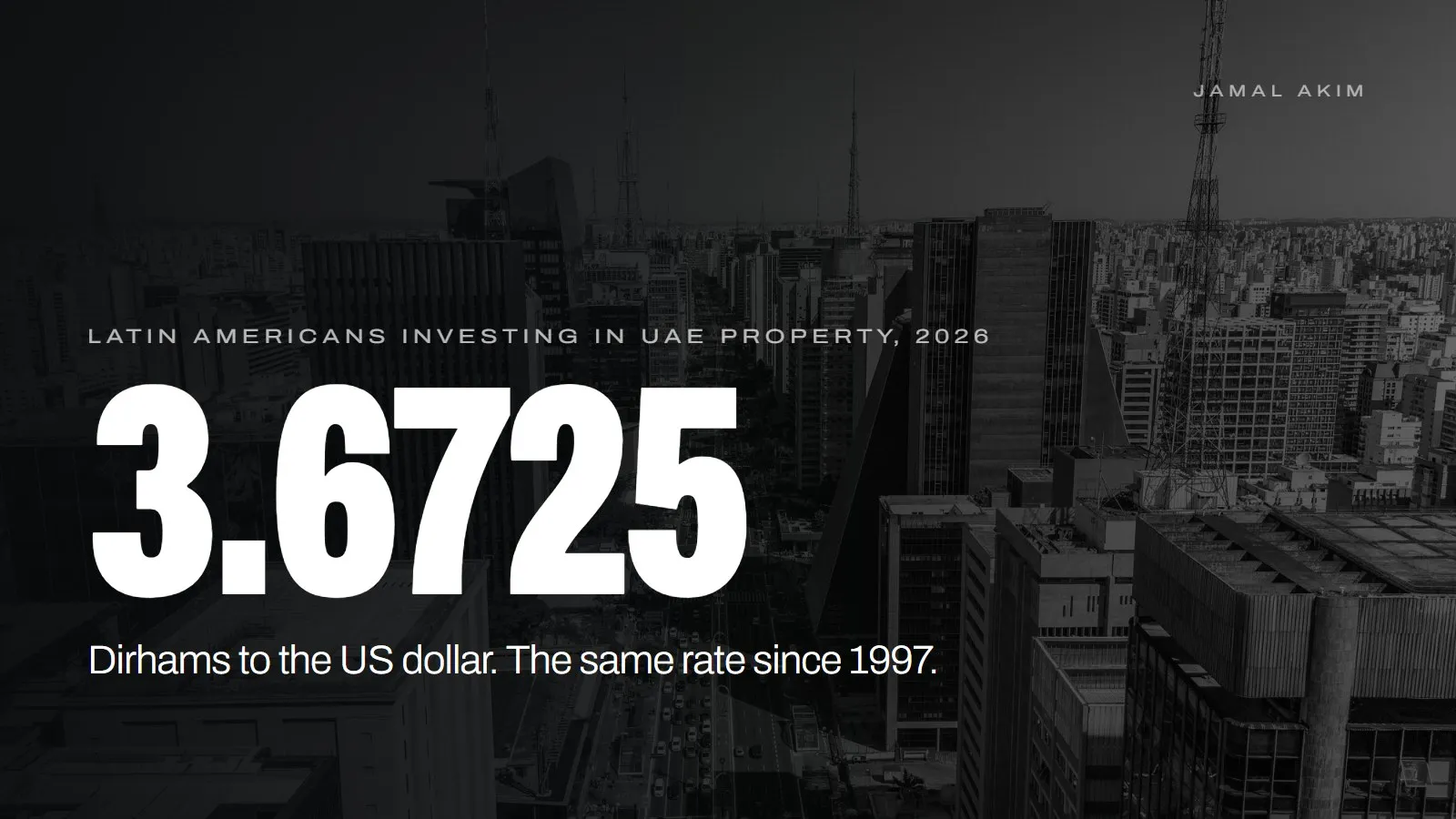
- The UAE dirham has been pegged to the US dollar at 3.6725 since 1997, so UAE property behaves like a dollar asset.
- Dubai gross rental yields averaged roughly 6 to 7% in 2026 market reports. On Numbeo’s city-centre data, Dubai sits near 7.5%, against about 3.4% in London.
- Property valued at AED 2 million or more can qualify for a 10-year Golden Visa. It does not change your passport’s travel rights.
- There is no personal income tax in the UAE, and foreigners can own freehold property in designated areas.
- Emirates flies São Paulo to Dubai non-stop. Most other Latin American cities are one connection away.
The story: why two regions found each other
My family’s story is a migration story. Jamaican by way of Cuba and Panama. Saint Lucian by way of Guyana. Sudanese roots on the other side. People from the Caribbean have always moved to where the work and the opportunity were. They built the Panama Canal. They cut cane in Cuba. They went where the fundamentals were.
That is exactly what I see happening now between Latin America and the Gulf.
Ten years ago, if a Brazilian family had money to protect, the playbook was simple: Miami, Lisbon, maybe Madrid. Today the conversation includes Dubai and Abu Dhabi, and it is not about luxury. It is about three things that Latin American investors understand better than almost anyone in the world.
- Currency. If you have watched your savings lose half their value, you think differently about what a stable currency means.
- Safety. If you have had to think about which car to drive or which route to take home, safety is not a lifestyle perk. It is the whole point.
- Optionality. If your country’s politics can change in one election, you want a second base. A plan B that is really a plan A.
The UAE answers all three. That is the story. Now let’s check it against the numbers.
The numbers: five reasons the money is moving
1. The dirham is a dollar in a different suit
The UAE dirham has been pegged to the US dollar at AED 3.6725 to USD 1 since 1997. Not a band. Not a managed float. A fixed rate, held for nearly three decades, through the 2008 crash, the 2014 oil collapse and the pandemic.
For a Latin American investor, that changes the risk picture completely. When you buy in Dubai, you are effectively buying a dollar-denominated asset, with rent paid in a dollar-linked currency, in a country with no personal income tax.
If you are from Panama or Ecuador, which already use the US dollar, there is no new currency risk at all. If you are from Brazil, Colombia or Mexico, your exposure is the same one you already hedge when you hold dollars.
2. Rental yields that are hard to find elsewhere
This is the number that makes the left brain sit up.
- Dubai7.5%
- New York5.3%
- London3.4%
See the numbers
| Item | Value |
|---|---|
| Dubai | 7.5% |
| New York | 5.3% |
| London | 3.4% |
Gross, before service charges, vacancy and management. Built from user-submitted listings, so treat it as a guide; 2026 market reports put Dubai's blended average at roughly 6 to 7%.
London and New York are where Latin American money has traditionally gone. Dubai earns more on the same dollar, and that gap is the reason so many of my calls now start in Spanish or Portuguese.
Two honest notes, because this is where people get sold a dream.
- Gross is not net. Service charges, management, vacancy and furnishing usually take 1 to 2 points off.
- Yields are compressing. Prices have been rising faster than rents. That is good for owners who already bought, and it means new buyers need to choose carefully. Not every tower is a 7% tower.
My Dubai against the world page has the full city table with sources.
3. Safety you can measure
On Numbeo’s January 2026 safety index, Abu Dhabi ranked as the safest city in the world, and Dubai came sixth. By the mid-year update, Ajman had nudged Abu Dhabi into second place, with Dubai still sixth. Five UAE cities sat inside the global top ten.
Crowdsourced indexes are not perfect, and I want to be straight with you about one more thing: the January figures were collected before the regional conflict in February 2026, when a missile was intercepted over Abu Dhabi. I wrote about what that meant for the property market in the Iran and UAE de-escalation piece. Read the news and make your own call.
But when I talk to Latin American parents who have moved here, the measure they use is simpler: my daughter takes a taxi home at midnight and I go to sleep. That sentence sells more property than any brochure.
4. Residency that lasts ten years
Property valued at AED 2 million or more, roughly USD 545,000, can qualify you for the UAE’s 10-year Golden Visa, which can include your spouse and children.
Smaller budgets are not locked out. A two-year property investor visa is also available, and its rules have been loosened in recent years.
One correction I make on almost every call: a UAE Golden Visa does not give you visa-free travel to other countries. Your passport decides that. What the UAE gives you is the base: a residency that does not depend on an employer, and an airport that connects you to most of the world in one flight.
5. A business base with no personal income tax
The UAE has no personal income tax. Corporate tax was introduced at 9% on profits above AED 375,000, and qualifying free zone companies can still benefit from 0% on qualifying income. Foreigners can own 100% of companies in free zones and in most mainland activities.
For a Latin American entrepreneur, that means you can set up a holding or trading company in a time zone that overlaps with Asia, Europe and Africa in the same working day.
The bridge: how Latin America physically connects to the UAE
Distance is the first objection. Here is the reality.
Latin America to Dubai, by air
- Emirates service to Dubai
- One connection, via Europe, the US or São Paulo
São Paulo to Dubai is one overnight flight. Emirates also links Rio de Janeiro and Buenos Aires to Dubai on a single route. From Panama City, Bogotá, Caracas, Port of Spain or Georgetown it is one connection, usually through Europe, the US or São Paulo. That is the same effort as flying to Asia, and once you land in Dubai, a huge share of the world is within an eight-hour flight.
Trade is catching up with travel. The UAE’s Comprehensive Economic Partnership Agreements with Costa Rica (in force April 2025) and Chile (in force November 2025) are already working. Colombia has signed one, and Ecuador signed in 2026, with tariffs coming off more than 96% of goods. Non-oil trade between the UAE and the Mercosur bloc reached USD 6.2 billion in 2025, and the UAE is pushing for a deal with the whole bloc.
Governments are building the bridge. Investors are walking across it.
Country by country
Each guide below goes deeper on one market.
| Country | Why the UAE fits | Guide |
|---|---|---|
| Panama | Already a dollar economy, so the UAE feels familiar: a trade hub with a dollar-linked currency | Panama to the UAE |
| Venezuela | A diaspora of millions rebuilding stability, often relocating rather than just investing | Venezuelans moving to the UAE |
| Brazil | A volatile real, high domestic rates and the only non-stop Emirates link to South America | Brazilian investors |
| Trinidad and Guyana | Energy money looking for a second base; Guyana is one of the fastest-growing economies on earth | Trinidad, Guyana and the UAE |
Colombia, Ecuador, Chile, Mexico and the rest of the region
The four deep dives cover Panama, Venezuela, Brazil, Trinidad and Guyana. But the bridge runs across the whole region.
- Colombia. One of the first Latin American countries to sign a trade agreement with the UAE. Bogotá is one stop from Dubai. Colombian buyers I speak to are usually after dollar income and a safe second base for family.
- Ecuador. Already a dollar economy, like Panama. Its agreement with the UAE, signed in 2026, removes tariffs on more than 96% of traded goods. Zero currency risk on UAE property.
- Chile. Agreement in force since November 2025. Chilean investors tend to be disciplined, data led and focused on yield.
- Costa Rica. The first agreement in the region to come into force, in April 2025.
- Argentina. Emirates serves Buenos Aires. After years of currency controls, Argentine buyers understand the value of a fixed peg better than anyone.
- Mexico. A growing community in the UAE and a consulate in Dubai. Mexican founders increasingly use the UAE as a door to the Middle East and Asia.
Different countries, same three reasons: currency, safety and optionality.
How a Latin American buyer actually buys
The process is simpler than most people expect, and you can do most of it remotely.
- Brief. Budget, goal (yield, growth, residency or a home), timeline and which emirate.
- Shortlist. Three to five units that fit, with honest numbers on service charges and comparable rents.
- Reserve. A booking deposit, often 5 to 10% on off-plan.
- Contract and registration. The sale and purchase agreement, then registration with the land department. In Dubai the transfer fee is 4%; in Abu Dhabi registration is around 2%.
- Payment plan. Off-plan is paid in instalments during construction. Some plans run past handover.
- Handover and visa. You receive the keys and title deed, then apply for residency if the property qualifies.
Money can be wired from your home bank in dollars. Ask your bank early about the paperwork it needs for an international property payment, because in some Latin American countries that step takes longer than the purchase itself. My guide to UAE property explains the SPA, Oqood and the rest of the vocabulary, and the fees page lists every cost.
If you buy off-plan, think about who you will sell to. Before completion your buyer is another investor. At completion, mortgage buyers and end users arrive.
The four phases of price appreciation
- 01Off-planInvestorsCash and payment plans
- 02ConstructionInvestorsA small, tight pool
- 03CompletionLeveraged buyersBanks lend; mortgages arrive
- 04MaturityEnd usersBuying a home, not a flip
I go through the cash maths in developer vs resale, and if you will need finance, read non-resident mortgages in Dubai.
Three questions to answer before you call anyone
Before you speak to me or any agent, get clear on three things. It will save you weeks.
- What is the money for? Dollar income, a home for the family, residency, or a long-term store of value. Each one points to a different building.
- When might you need it back? If the answer is within three years, buy something easy to sell, not a project that hands over in 2030.
- Who decides at home? Many Latin American purchases are family decisions. Bring everyone into the first call, so the shortlist fits the whole family and not just one person.
If you can answer those three, the rest of this guide becomes a checklist rather than a research project.
Where the smart money is looking
I am based in Dubai, but I spend a lot of time on Abu Dhabi. My short version:
- Dubai for liquidity, rental demand and choice. The deepest resale market in the region.
- Abu Dhabi for long-term fundamentals. Saadiyat Island has the Louvre Abu Dhabi and the Zayed National Museum, with the Guggenheim Abu Dhabi due to follow. ADGM, the financial centre on Al Maryah Island, has brought global names like BlackRock to the city, and its workforce grew 34% in a year.
Abu Dhabi is where I see a cultural district, a financial centre and a beach being built on the same island. Move those fundamentals to any other city and prices would follow. That is the logic I invest on, and I break down the financial district in Al Maryah vs Al Reem.
My take
I am not going to tell you the UAE is risk free. Nothing is. Prices can soften, yields are compressing, and you need the right unit in the right building from the right developer.
But if you have grown up with currency crises, inflation or insecurity, the UAE offers an unusual combination: a dollar-linked currency, strong rental income, a ten-year residency route and some of the safest cities in the world. All in one place.
That is the bridge I am building. Latin America to the UAE. And the network on the other side keeps growing. If you are in São Paulo, Panama City, Caracas, Bogotá or anywhere in between, message me or book a call.
General information, not financial, legal or immigration advice. Figures are indicative and were checked in October 2026; yields, visa rules, fees and flight routes change. Confirm current details with the Dubai Land Department, Abu Dhabi’s ADREC, the ICP or GDRFA and a licensed adviser before you commit.
Frequently asked questions
Can Latin Americans buy property in Dubai and Abu Dhabi?
Yes. Foreign nationals can buy freehold property in designated areas of Dubai and Abu Dhabi, whatever their nationality. You do not need to live in the UAE or hold a UAE visa to buy. You need a valid passport and, for off-plan, the developer's identity and source-of-funds checks.
Does buying property get me a UAE Golden Visa?
Property valued at AED 2 million or more, about USD 545,000, can qualify for the 10-year Golden Visa. The valuation is the land department's figure, not just your purchase price. Rules on mortgaged and off-plan units change, so confirm the current criteria with the Dubai Land Department or the ICP or GDRFA before you rely on it.
Does a UAE Golden Visa let me travel visa-free to Europe or the US?
No. A UAE residence visa lets you live in the UAE. Your passport still decides where you can travel visa-free. What the UAE gives you is a base: one of the most connected airports in the world and a residency that does not need renewing every year.
What currency risk do I take buying in AED?
The dirham has been pegged to the US dollar at 3.6725 since 1997. If you think in dollars, AED property behaves like a dollar asset. Your risk is mainly between your home currency and the dollar, which most Latin American investors already manage.
What rental yields can I expect in Dubai?
Gross rental yields in Dubai have been running at roughly 6 to 7% on average in 2026 market reports, with some apartment segments higher and prime villas lower. Net yields after service charges and management are typically 1 to 2 points lower, and yields have been compressing as prices rise faster than rents.
Sources
- Khaleej Times (1 July 2026): UAE in talks with Mercosur after $6.2bn non-oil trade in 2025
- WAM (24 November 2025): UAE-Chile CEPA enters into force
- UAE Ministry of Economy: UAE-Costa Rica CEPA (in force 1 April 2025)
- Gulf Business (2026): UAE signs CEPAs with Japan and Ecuador
- Gulf News (5 November 2018): Dubai Chamber opens office in Panama
- Gulf News (2026): World's top 10 safest cities for 2026 (Numbeo)
- Numbeo: property investment pages (city-centre gross yields), opened 12 October 2026
- Business Traveller: Emirates returns to Rio de Janeiro and Buenos Aires
Considering an investment in Dubai?
Send me your budget, timeframe and objective and I'll give you my view on where I'd start.