
Trinidad, Guyana and the UAE: a guide for Caribbean investors
When people ask where I am from, the honest answer takes a while.
British. Raised in London. Jamaican by way of Cuba and Panama. Saint Lucian by way of Guyana. Sudanese roots on the other side. Based in Dubai.
That link, Saint Lucia by way of Guyana, is why this article matters to me. The southern Caribbean is part of my family’s story. And right now, something historic is happening there. Guyana has become one of the fastest-growing economies on earth. Trinidad and Tobago has been an energy economy for a century. Both are producing a generation of investors who are asking the same question.
Where do we build our second base?
More and more of them are looking at the UAE.
Key takeaways
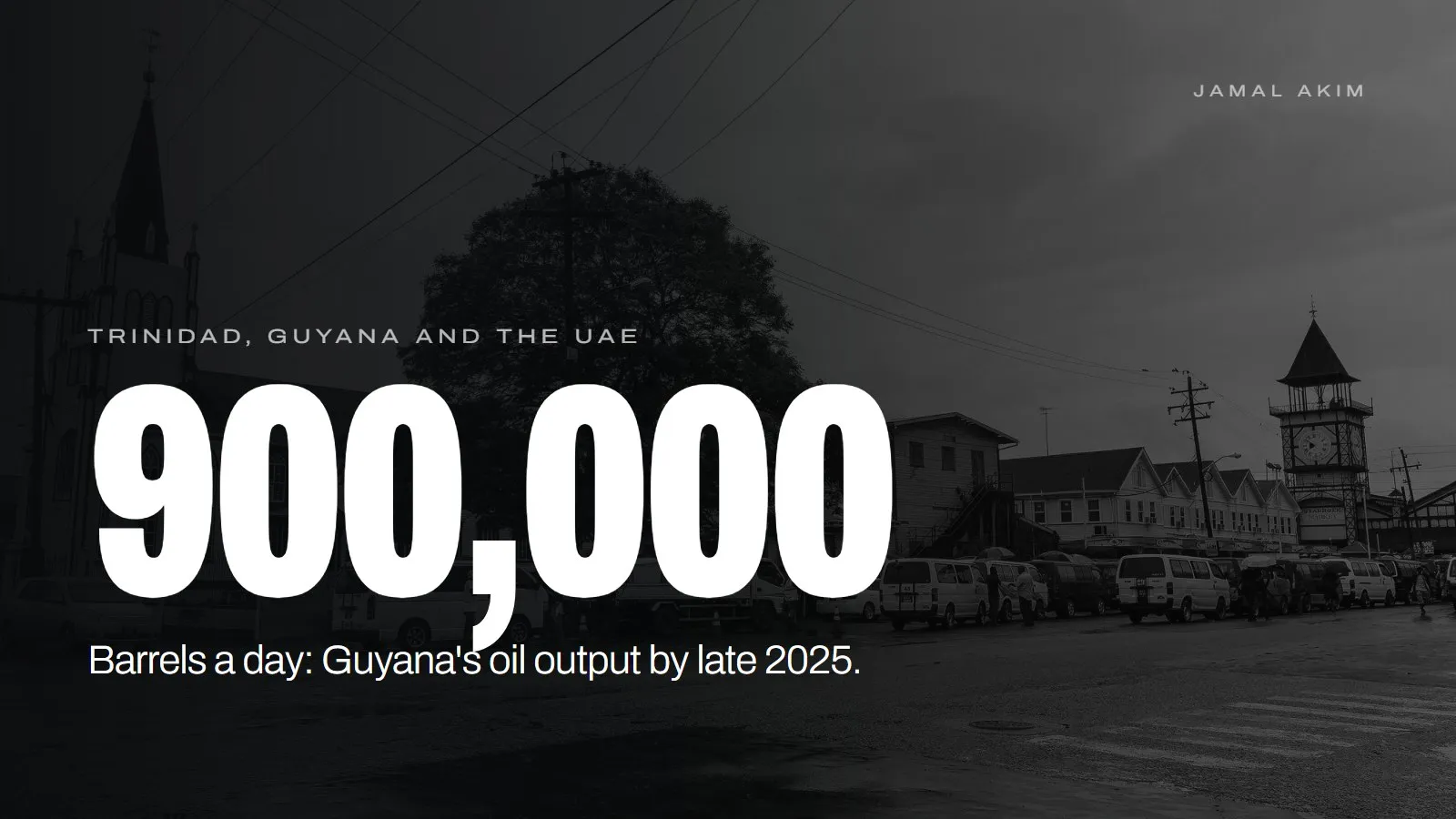
- Guyana’s economy grew by an average of about 47% a year from 2022 to 2024 (IMF), and by about 15% in 2025 (World Bank), with oil output above 900,000 barrels a day by late 2025.
- Trinidad and Tobago has been an energy economy for over a century and is one of the world’s leading exporters of ammonia and methanol.
- About three quarters of the UAE’s economy now comes from outside oil and gas.
- UAE property gives Caribbean investors a dollar-linked asset outside their home energy cycle.
- There are no direct flights yet. Plan on one connection.
The story: oil changes everything, if you let it
I have spent years watching how the UAE handled its oil wealth. The short version: it treated oil as a starting point, not the destination.
Abu Dhabi saved through sovereign funds. It built Etihad, ADGM, Saadiyat Island’s cultural district and now Etihad Rail. Dubai, with far less oil, built ports, an airline, tourism and a property market that people from some 200 nationalities buy into. Today, by the UAE’s own figures, roughly three quarters of the economy comes from outside oil and gas.
Now look at Guyana.
- 202262%
- 202333%
- 202444%
- 2025World Bank estimate15%
See the numbers
| Item | Value |
|---|---|
| 2022 | 62% |
| 2023 | 33% |
| 2024 | 44% |
| 2025 (World Bank estimate) | 15% |
Rounded. Sources differ by a few points: the IMF puts average growth from 2022 to 2024 at about 47% a year, and the World Bank estimated 2025 growth at 15.4% in April 2026. Even the lowest figures are among the fastest in the world.
Source: IMF 2025 Article IV consultation; World Bank Macro Poverty Outlook, April 2026
Growth rates like these are almost unheard of. Oil output passed 900,000 barrels a day in late 2025. Guyana has a Natural Resource Fund to save part of the windfall. The question for Guyanese families and businesses is the one Abu Dhabi faced fifty years ago: how do you turn a resource boom into generational wealth?
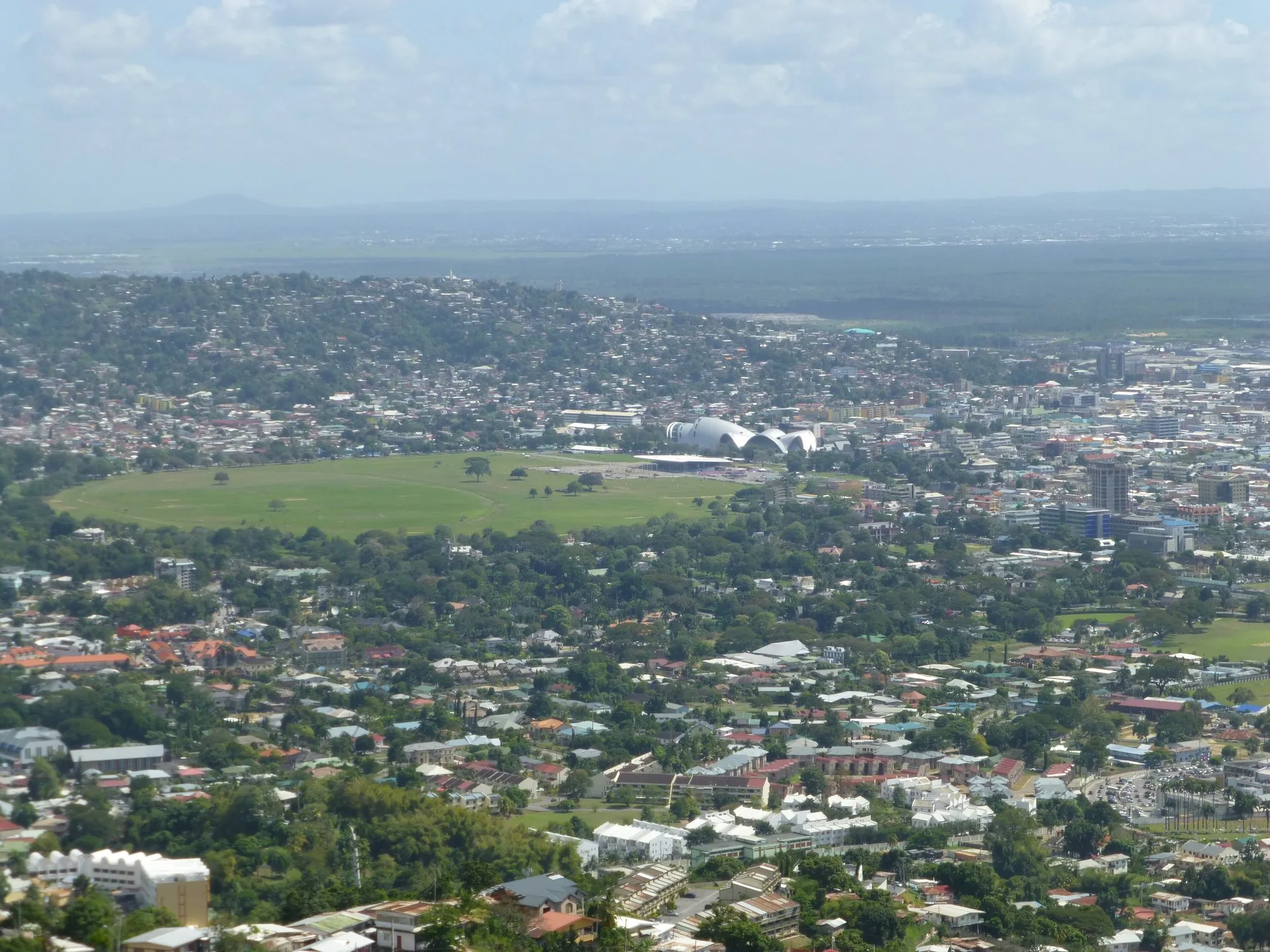
Trinidad and Tobago knows the other side of that story. It has been an oil and gas producer for over a century and is one of the world’s leading exporters of ammonia and methanol. It has seen booms and it has seen busts. Trinidadian investors understand cycles, and they understand why you do not keep everything in one place.
The numbers: why the UAE fits Caribbean energy money
A dollar-linked asset, outside your home currency
Both economies have currency pressure points. Trinidad and Tobago’s dollar is managed against the US dollar, and businesses there have reported long-running difficulty getting hold of foreign exchange. Guyana’s dollar has been steady, but a resource economy can change quickly when oil prices move.
The UAE dirham is pegged to the US dollar at 3.6725, and has been since 1997. Buying property in Dubai or Abu Dhabi gives you a hard-currency asset that pays rent in a dollar-linked currency, outside the energy cycle of your home country.
Rental yields that pay you to wait
Dubai’s average gross rental yields have run at roughly 6 to 7% in 2026 market reports, well above London’s typical 3 to 4%. For an investor whose main wealth is in an energy business or local property, that income stream is a useful counterweight.
The caveats I always give: gross is before service charges and management, and yields have been compressing as prices rise. The building you choose matters more than the city average.
A city built for energy people
There is a practical point too. The UAE is one of the world’s major energy hubs. ADNOC, the global majors and the service companies all have a presence. Guyanese and Trinidadian engineers, executives and contractors often find their skills translate directly.
For energy professionals, the UAE can be more than an investment. It can be the next posting.
Residency, tax and safety
- Golden Visa. Property valued at AED 2 million or more, roughly USD 545,000, can qualify for a 10-year residency for you and your family. It does not change your passport’s travel rights; it gives you a base.
- Tax. No personal income tax in the UAE. Corporate tax is 9% above AED 375,000 of profit, with 0% possible on qualifying free zone income.
- Safety. In Numbeo’s January 2026 index, Abu Dhabi ranked first in the world and Dubai sixth. Those figures came before the regional conflict in February 2026, so stay informed. For many Caribbean families, everyday safety is the reason in itself.
What Guyana can learn from Abu Dhabi
I am a property person, not a policymaker. But I think about this a lot, because it is the story of generational wealth at country level and at family level.
- Save the windfall. Abu Dhabi built sovereign funds before it built skyscrapers. Families can do the same: put part of the boom into assets that pay you whether oil is at 50 or 100 dollars.
- Build fundamentals. Saadiyat Island now has the Louvre Abu Dhabi and the Zayed National Museum, with the Guggenheim Abu Dhabi due to follow. Culture, education and infrastructure create value that outlasts any commodity.
- Invite the world in. The UAE grew by welcoming talent and capital from everywhere. Openness is a growth strategy.
- Think in generations. The decisions made in the 1970s still pay dividends today. The same is true for a family portfolio.
That is the logic I apply to property. Move Abu Dhabi’s fundamentals to any other city, and money would follow. Guyana now has the chance to build its own.
Questions Caribbean investors ask me
Can I buy through a company? Often, yes, but it changes the paperwork, the bank’s view and possibly your tax at home. Many buyers keep it simple and buy personally. Get advice in your home country before deciding.
Can family members co-own? Yes. Joint ownership is common. Agree in writing who pays what and what happens if one owner wants to sell.
What happens if I die? This is the question most buyers skip. Without a registered will, UAE succession can follow rules you did not intend. Non-Muslims can register wills through the DIFC Courts Wills Service in Dubai or with the Abu Dhabi Judicial Department. It is one of the smartest small costs in the whole purchase.
Who manages it while I am in Port of Spain or Georgetown? A licensed property manager, paid a percentage of rent, handles tenants, maintenance and service charges. Choose one with clear monthly statements.
When should I sell? If you bought off-plan, completion is usually the moment the buyer pool widens, because mortgage buyers and end users arrive. If you are holding for income, the right answer may be never. That is how Abu Dhabi thought about its assets, and it is how generational wealth is built.
The four phases of price appreciation
- 01Off-planInvestorsCash and payment plans
- 02ConstructionInvestorsA small, tight pool
- 03CompletionLeveraged buyersBanks lend; mortgages arrive
- 04MaturityEnd usersBuying a home, not a flip
The practical part
- Travel. No direct flights from Port of Spain or Georgetown at the time of writing. Most routes connect through North America, Europe or São Paulo. Check visa rules for your passport with the ICP before booking.
- Source of funds. UAE developers and banks will ask how you earned the money. Contracts, company accounts, dividend records and bank statements make this simple.
- Transfers. International wires in US dollars are routine. In Trinidad and Tobago, plan ahead for foreign exchange availability.
- Fees. Dubai’s land department fee is 4%. Abu Dhabi’s registration fee is around 2%. Budget for agency and admin costs; every line is on my fees page.
- Remote purchase. Most documents can be signed digitally. A power of attorney can complete a ready property transfer without you flying in.
Where Caribbean investors tend to start
- Abu Dhabi: Saadiyat and Yas. Long-term fundamentals, culture and beaches, with Disney planned on Yas.
- Dubai Marina and JBR. Waterfront living and strong short-let demand. Familiar to anyone who loves Maracas Bay.
- Business Bay and Downtown. Rental demand from professionals.
- Off-plan with a payment plan. Spread the cost across construction, and read developer vs resale before you choose.
A family plan, worked through
Here is how I would sketch it for a Guyanese family that has just sold a business or a block of land for USD 1 million.
- About USD 600,000 stays at home, in the business, local property and savings, where the growth is.
- About USD 400,000 goes into one UAE apartment, bought outright, in a building with steady rental demand.
At a 6.5% gross yield, that apartment rents for about USD 26,000 a year. After service charges, management and a month of vacancy, call it USD 20,000 a year, in a currency tied to the dollar, from an economy that no longer depends on oil.
If oil falls and Georgetown cools, that rent keeps coming. If oil stays high, you have simply added a second engine. Either way, the family is no longer betting everything on one commodity.
It is not the only way to do it, and the right split depends on your circumstances and advice. But it is the shape of the idea.
The diaspora link: London, New York and Toronto
A big share of my Caribbean clients do not live in the Caribbean. They live in London, New York, Toronto and Miami, with family and roots back in Port of Spain, Georgetown, Kingston or Castries.
That matters, because the diaspora often has the income, the credit history and the banking access to buy, while family back home brings the sense of where the opportunity is.
For a diaspora buyer, the UAE can sit neatly between the two worlds. It is a time zone that overlaps with London’s working day, a dollar-linked asset, and no personal income tax in the UAE itself, although your home country may still tax the rent.
My Caribbean page covers the wider region, and the non-resident mortgage guide explains how buyers abroad finance a purchase.
The risks, said plainly
- Distance and travel time. You will connect at least once.
- Market cycles. Prices have risen strongly. Buy for a mid to long hold, not a quick flip.
- Supply. Dubai has a large pipeline of new homes. Choose carefully.
- Regional context. Daily life in the UAE is very safe, but read the news on the wider region and make your own decision.
What Trinidad’s cycles can teach a Guyanese investor
Trinidad and Tobago has lived through more than one energy boom and more than one bust. When prices were high, money flowed into local property, cars and imports. When prices fell, foreign exchange became scarce, and the people who had kept everything at home felt it most.
Guyana is at the start of its own story, with growth rates the world has rarely seen. The lesson from Port of Spain is not to fear the boom. It is to diversify during it.
That can mean a business at home and a property abroad. Local assets for growth, and a dollar-linked asset that pays rent whatever oil does. Abu Dhabi did exactly that at national scale, and it is why its economy no longer rises and falls with the oil price alone.
The best time to build a second base is while the first one is booming.
My take
The Caribbean has always been a region of movers. My family’s routes ran through Jamaica, Cuba and Panama, through Saint Lucia and Guyana, and then to London. I moved again, to Dubai. Each move followed opportunity.
Guyana and Trinidad are now generating the kind of wealth that, handled well, lasts for generations. The UAE is the best example I know of a country that did exactly that, and its property market lets you own a piece of that story.
I am building a bridge from the Caribbean and Latin America to the UAE. If you are in Georgetown, Port of Spain, San Fernando or anywhere in between, message me or book a call. Let’s talk about what generational looks like for you. The wider picture is in my guide for Latin American investors.
General information only, not financial, legal, tax or immigration advice. Figures are indicative and were checked in October 2026; growth estimates differ by source, and yields, fees, visa rules and flight routes change. Confirm details with the Dubai Land Department, the ICP or GDRFA and licensed advisers in your home country and the UAE.
Frequently asked questions
Can Trinidadians and Guyanese buy property in the UAE?
Yes. Freehold property in designated areas of Dubai and Abu Dhabi is open to all nationalities, with no requirement to live in the UAE. You need a valid passport and documented source of funds.
How do I get from Trinidad or Guyana to Dubai?
There is no direct flight at the time of writing. Most travellers connect through North America, Europe or São Paulo. Visa requirements depend on your passport and change over time, so check the ICP's current list before you travel.
Why would Caribbean energy money look at Abu Dhabi?
Abu Dhabi is one of the clearest examples in the world of an oil economy that saved, diversified and built long-term assets. Today about three quarters of the UAE's economy comes from outside oil and gas. For investors from Guyana and Trinidad, it is both an investment destination and a case study.
What is the minimum property value for a UAE Golden Visa?
Property valued at AED 2 million, about USD 545,000, can qualify for a 10-year Golden Visa. Confirm the current criteria for off-plan and mortgaged property with the Dubai Land Department or the ICP or GDRFA.
Sources
- IMF (May 2025): Executive Board concludes 2025 Article IV consultation with Guyana
- World Bank: Guyana Macro Poverty Outlook (April 2026)
- US International Trade Administration: Guyana country commercial guide (oil output above 900,000 barrels a day in late 2025)
- Ministry of Finance, Guyana: Natural Resource Fund
- UAE Ministry of Economy and Tourism: economic indicators
- Gulf News (2026): World's top 10 safest cities for 2026 (Numbeo)
- DIFC Courts Wills Service
Considering an investment in Dubai?
Send me your budget, timeframe and objective and I'll give you my view on where I'd start.