
Iran, the UAE, and What It Means for Dubai Property Right Now

The last month has been tense for the region, and I’m not going to pretend property was the main story. On 18 August, the UAE reported Iranian missiles fired toward its territory, one landing in its waters, and suspended trade with Iran the next day. On 3 September, Iranian forces struck at US bases in Kuwait and the UAE. That’s the backdrop anyone buying or selling here has been operating in for weeks.
Then, over the last few days, the tone shifted. Iran and the UAE joined a joint BRICS statement urging restraint, Iran’s president met the Crown Prince of Abu Dhabi on the sidelines of the BRICS summit in New Delhi, and Tehran is now unveiling a temporary shipping lane agreement through the Strait of Hormuz, worked out with Oman, to Gulf nations directly. Iran’s president put it plainly: both sides want to “turn the page.”
What actually happened to the property market while this was going on
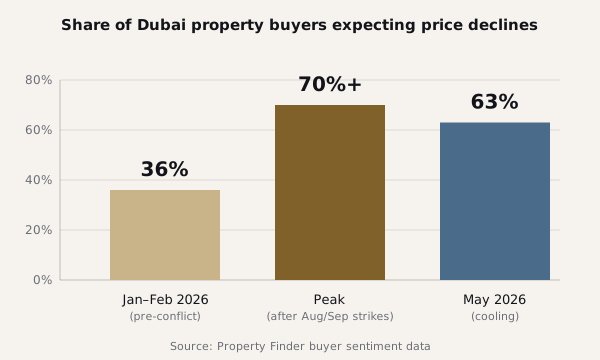
This is the part worth paying attention to, because it’s measured, not guessed at. Before the conflict, in January and February, buyer sentiment was fairly balanced: 36% expected prices to fall, 35% expected growth, 29% expected things to hold steady. Once the missile exchanges started, that flipped hard. The share of buyers expecting price declines went above 70%.
Sellers, on the whole, didn’t blink. Asking prices sat only around 1% below pre-conflict levels in April and about 2% below in May, nowhere near what the buyer sentiment numbers would suggest. Cherif Sleiman, Chief Revenue Officer at Property Finder, described the standoff well: “When buyers and sellers sit far apart on price, deals take a pause, and that distance is exactly what’s narrowing now.”
That pause showed up somewhere specific: the rental market. New rental contracts were 32% below pre-conflict volume in March, as buyers who’d normally be transacting sat it out and rented instead. By May that gap had narrowed to 20% below, and 47% of that rental activity was people moving into new properties rather than renewing, up from 41% in March, which tells you these weren’t just nervous renewals. People who intended to buy were renting while they waited to see what happened.
None of this stopped the wider market. Dubai recorded AED 523.44 billion in transactions across the first eight months of 2026, already 57% of everything transacted in the whole of 2025. In the single week of 7 to 11 September, as the diplomatic story was actively breaking, the market still moved AED 10.67 billion, AED 6.78 billion of that in sales alone. Whatever hesitation existed at the individual buyer level, it wasn’t a market-wide freeze.
My read on what changes now
Here’s where I’ll give you my opinion rather than just the numbers, because that’s what you’re actually here for.
Sellers who held their pricing through August and September, while a chunk of the buyer pool sat on the sidelines expecting a discount that didn’t materialise, are going to come out of this more confident, not less. They watched the market absorb a genuine regional flashpoint without asking prices moving more than a couple of percent. That’s not a group that’s about to get softer on negotiation. I’d expect the opposite: sellers who weathered this are likely to hold firmer on price than they were even before the conflict started, because they now have direct evidence their asking price survived a real stress test.
Buyers who were waiting for prices to fall, and renting in the meantime rather than transacting, were making a bet that uncertainty would eventually force sellers to move. With Iran and the UAE visibly walking this back, that uncertainty is exactly what’s disappearing, and it was the main leverage those buyers had. I don’t think a de-escalation like this hands buyers a better negotiating position. If anything it removes the one card they were holding.
None of that means chase a deal out of fear of missing a window. It means the “wait and see” approach that made sense in August makes less sense now that the thing being waited on is resolving. If a property made sense on fundamentals before this started, that hasn’t changed. What’s changed is the excuse to keep waiting.
Where this leaves an actual decision
This is exactly the kind of moment where price alone tells you nothing useful. What a property costs, what it actually makes, and what could still go wrong are still the right questions, laid out in the KISS method. Geopolitics moves faster than most people’s due diligence, which is precisely why the due diligence has to stay boring and consistent regardless of what’s in the headlines that week.
Market and geopolitical commentary based on the sources cited above, current as of publication. This is my professional read, not a forecast or a recommendation to act. Regional developments can reverse quickly, so treat this as context for your own due diligence, not a substitute for it.
Frequently asked questions
How did the Iran and UAE tension affect Dubai property prices?
Buyer sentiment turned sharply, with more than 70% expecting declines, but asking prices stayed only about 1% below pre-conflict levels in April and about 2% below in May. Sellers largely held their pricing.
Did Dubai property transactions stop during the 2026 regional tension?
No. Dubai recorded AED 523.44 billion of transactions in the first eight months of 2026, already 57% of the 2025 total, and AED 10.67 billion in the week of 7 to 11 September alone.
What happened to Dubai rents during the conflict?
New rental contracts fell 32% below pre-conflict volume in March and recovered to 20% below by May, as some would-be buyers rented while they waited.
Is it a good time to buy Dubai property after the de-escalation?
If a property made sense on fundamentals before the tension, that has not changed. What has changed is the reason to keep waiting: de-escalation removes the uncertainty that gave waiting buyers leverage. It is still a decision for the numbers, not the headlines.
Sources
- Haaretz: Iran and UAE back joint BRICS statement urging restraint in the war
- anews: Iran president says Tehran and UAE want to turn the page on war
- Al Jazeera: UAE imposes indefinite trade embargo on Iran over alleged missile attacks
- Business Standard: Iran set to unveil temporary Hormuz shipping lane pact to Gulf nations
- UAE property buyers soften price-drop expectations as sellers hold firm
- The Week: Dubai real estate transactions surpass AED 10 billion in just 5 days
Considering an investment in Dubai?
Send me your budget, timeframe and objective and I'll give you my view on where I'd start.