
ROI vs ROE: What Property Investors Should Actually Measure

Ask two different people for a property’s “return” and you’ll often get two different numbers, calculated two different ways, both technically correct, because ROI and ROE are answering different questions.
The core difference
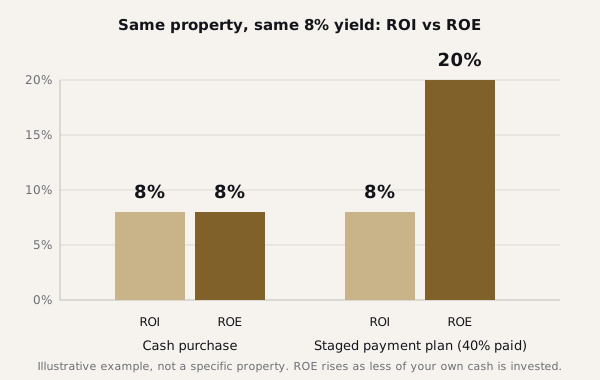
ROI (Return on Investment) measures return against the full property value. ROE (Return on Equity) measures return against the actual cash you’ve put in so far. On a fully cash-purchased property, these two numbers are close to identical. On a property bought through a staged payment plan, they can diverge significantly: your ROE looks much higher early on because your actual cash outlay is smaller relative to the income the property eventually generates.
Why this matters more with Dubai payment plans
Post-handover and staged construction-linked payment plans are common in the Dubai off-plan market. A payment plan that spreads your capital outlay over several years means your actual invested equity, and therefore your ROE, looks different at each stage of that plan, while ROI, calculated against the full property value, stays comparatively stable.
The practical takeaway
When a figure is presented as “the return,” ask specifically which one it is and how it’s calculated. Neither is more legitimate than the other, but a headline number that doesn’t specify which one it’s measuring is worth double-checking rather than taking at face value.
(This piece expands the Financial category from the full investment framework.)
The framework
What ROI actually measures
- Return on the full purchase price: annual net income divided by total property value
- Useful for comparing across different properties on a like-for-like basis, regardless of how each was financed
- Doesn't account for how much of your own capital is actually tied up if you used a payment plan or mortgage
What ROE actually measures
- Return on the equity you've actually put in: annual net income divided by your actual cash invested so far
- This is the number that reflects a post-handover payment plan's real effect on your return
- Two identical properties can show very different ROE if one was bought cash and one on a staged payment plan
Why the gap matters in Dubai specifically
- Post-handover and staged payment plans are common here, which means ROI and ROE diverge more than in a typical cash market
- A developer or agent quoting a headline 'return' figure should be able to tell you which one they mean and how it's calculated
- Neither number is 'more correct'. They answer different questions, and conflating them is one of the more common mistakes in off-plan conversations
Frequently asked questions
What does "ROI vs ROE: What Property Investors Should Actually Measure" cover?
The same property can look very different depending which number you use.
What does the analysis look at?
It is organised under What ROI actually measures, What ROE actually measures, Why the gap matters in Dubai specifically. Return on the full purchase price: annual net income divided by total property value. Useful for comparing across different properties on a like-for-like basis, regardless of how each was financed.
How do I get the full report?
The full guide is on this page. If you want me to apply it to a property you are considering, send me the details.
Is this investment advice?
No. It is general market research and a framework for asking better questions. Your own decision should rest on the specific property, your finances and independent legal, tax and financial advice where you need it.