
Fixed or variable? Choosing a UAE mortgage rate when EIBOR is moving
Every mortgage conversation gets to the same question.
“Should I fix?”
The honest answer is: it depends what you can live with. Here’s how each option works in the UAE, and a simple way to decide.
Key takeaways
- Fixed: your rate is locked for 1, 2, 3 or 5 years. In November 2026, GCC Mortgages lists 1-year fixed from 3.75% and 5-year fixed from 4.19% for the best salaried profiles.
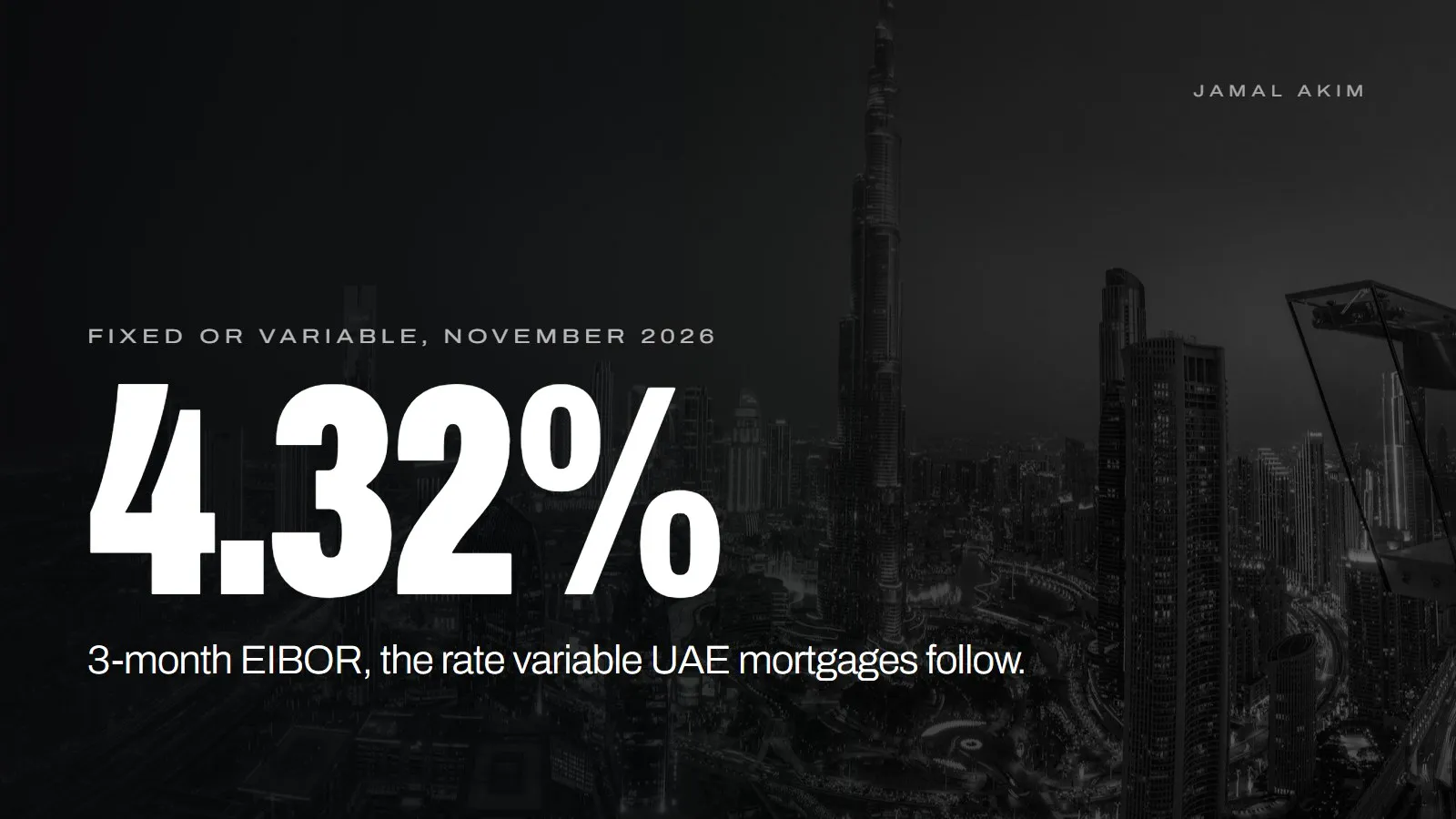
- Variable: the rate is 3-month EIBOR plus the bank’s margin. GCC lists margins from 0.40%, with 3-month EIBOR at 4.315%.
- When a fix ends, most loans revert to variable, often at a higher rate than a new bank would offer.
- UAE banks must stress-test you at 2 to 4 points above your rate, so you should too.
- Leaving early costs at most 1% of the balance or AED 10,000, plus any actual cost of breaking a fix.
Today’s rates
GCC Mortgages’ November 2026 table, for salaried applicants who transfer their salary to the bank:
| Product | From |
|---|---|
| 1-year fixed | 3.75% |
| 2-year fixed | 3.78% |
| 3-year fixed | 3.99% |
| 5-year fixed | 4.19% |
| Variable | 3-month EIBOR + 0.40% (about 4.72% today) |
Without salary transfer, self-employed or non-resident, expect higher. See the full UAE mortgage rates table, which GCC updates monthly.
You’ll notice the fixed rates are below the variable rate right now. Banks are pricing fixed deals to win business. That won’t always be true.
What it means in your monthly payment
On a AED 1.6 million loan over 25 years:
1-year fixed
3.75%
AED 8,226
5-year fixed
4.19%
AED 8,614
Variable today
about 4.72%
AED 9,090
And the stress test the bank will run on you:
Variable today
about 4.72%
AED 9,090
If rates rise 2 points
about 6.72%
AED 11,019
If rates rise 3 points
about 7.72%
AED 12,049
If AED 12,000 a month would break your budget, that tells you something.
How variable rates move
Variable UAE mortgages follow EIBOR. EIBOR follows the Central Bank of the UAE’s Base Rate. And the Base Rate follows the US Federal Reserve, because the dirham is pegged to the dollar.
The Central Bank raised its Base Rate from 3.65% to 3.90% on 17 September 2026, and held it on 28 October. I explain the chain in The Fed just raised rates: has Washington reached Dubai mortgages yet?
The part people forget: when the fix ends
A fixed rate isn’t for the life of the loan. At the end of the period, most loans move to the bank’s variable rate: EIBOR plus a margin that is often higher than a new customer gets. GCC Mortgages says that reversion rate is often 1 to 2 points higher than what another lender would offer.
So put the end date in your calendar. Three months before, compare. Moving can save real money. Here’s when a refinance or buyout makes sense.
How to choose
Fix if:
- A payment rise of AED 2,000 to 3,000 a month would strain you.
- It’s your family home and certainty matters more than the last 0.2%.
- You’re on a tight debt-to-income ratio.
Consider variable if:
- You have real room in your budget.
- You may sell or repay within a year or two and want flexibility.
- You believe rates will fall, and accept they might not.
Fix length:
- 1 to 2 years: the lowest rates today, but you face the market again soon.
- 3 years: a balance of rate and certainty.
- 5 years: the most certainty, at a slightly higher rate.
Don’t pick on headline rate alone. Ask about the margin after the fix, the arrangement fee and any break costs.
What the Central Bank protects you from
- Early settlement and partial settlement fees on home loans are capped at 1% of the outstanding balance or AED 10,000, whichever is less.
- Breaking a fixed rate can also cost the lender’s actual break cost.
- No barrier to refinancing. The rules say there should be no impediment to moving your mortgage to another bank.
- No changes without your agreement. Banks can’t vary your loan terms without your written agreement, and must give two months’ notice of fee changes.
How rates have moved
Variable mortgages follow EIBOR, and EIBOR has moved a lot in two years. Khaleej Times worked an illustrative borrowing rate of 3-month EIBOR plus a 1% margin:
| Period | Illustrative variable rate |
|---|---|
| Q1 2024 | 6.30% |
| Q1 2025 | 5.30% |
| Q2 2026 | 4.74% |
Then the Central Bank raised its Base Rate to 3.90% in September 2026, and 3-month EIBOR rose from about 3.6% in April 2026 to around 4.3% by October and November.
The lesson isn’t which way rates go next. It’s that a variable payment can change by a thousand dirhams a month or more within a couple of years, in either direction.
A three-year comparison
On a AED 1.6 million loan, today’s 3-year fixed from 3.99% costs AED 8,437 a month. The variable rate at about 4.72% costs AED 9,090, so AED 653 a month more.
- If rates stay where they are, the fix saves about AED 23,500 over three years.
- If rates fall by about 0.75 points soon, the two roughly even out.
- If rates rise, the fix saves more, and protects your budget.
Right now, with fixed rates priced below variable, fixing is the cheaper starting point unless you expect rates to fall quickly. That’s unusual, and it won’t last forever.
For investors: fixed or variable?
If you’re renting the property out, two extra things matter.
- The bank deducts empty months. Central Bank rules require banks to deduct at least two months’ rent when they count rental income for an investment property.
- Rent and payment move separately. Rents in Dubai have been easing in some areas while rates rose. A fixed rate keeps your cost steady while you find out where rents settle.
Most investors I work with fix, then review when the fix ends.
What happens to your payment when the fix ends
Say you fix for three years at 3.99%. When the fix ends, the bank moves you to its variable rate, typically 3-month EIBOR plus its margin. If EIBOR is around 4.3% and the margin 1%, that’s about 5.3%. On the balance left after three years, roughly AED 1.48 million with 22 years to go, the payment would rise from AED 8,437 to around AED 9,500.
That’s why the end of a fix is the moment to compare. A new bank may well offer you a better fixed deal. Here’s how refinancing works.
Eight questions to ask the bank
- What is the rate, and for exactly how long is it fixed?
- What does it revert to afterwards, and what is the margin over EIBOR?
- Which EIBOR tenor is used, 1, 3 or 6 months, and how often does the rate reset?
- Is there a minimum or floor rate?
- What would it cost to break the fix early?
- Can I make partial repayments, and what does each cost?
- What is the arrangement fee, and can it be waived?
- Does the rate require salary transfer, life insurance or other products with the bank?
Get the answers in writing on the offer letter.
Selling during a fixed period
Plans change. If you sell or repay while a fix is running:
- The early settlement fee is capped at 1% of the outstanding balance or AED 10,000, whichever is less.
- The bank can also recover its actual cost of breaking the fix, which depends on how rates have moved.
- Some banks let you move the mortgage to a new property instead. Ask before you fix whether this is possible.
If there’s a real chance you’ll sell within two years, a shorter fix or a variable rate keeps you flexible.
Choosing by life stage
First-time buyer. Budgets are usually tight and certainty matters. A 3- or 5-year fix keeps the payment steady while your income grows.
Growing family. School fees and childcare make surprises unwelcome. Fix, and keep a cash buffer.
Investor. Fix to match the period you expect to hold, then review. Remember the bank discounts rent by at least two months for empty periods.
Approaching retirement. If the loan runs past your retirement age, Central Bank rules require the bank to check that the remaining balance can still be paid at a 50% debt burden on your retirement income. A shorter term, or a larger repayment before you stop work, can help.
Partial repayments: a quiet way to save
You don’t have to refinance to pay less. Paying down a lump sum, for example from a bonus, reduces the balance and the interest on it. The Central Bank caps partial settlement charges on home loans at 1% of the outstanding balance or AED 10,000, whichever is less, and some banks allow a free amount each year. Ask your bank what it allows.
Why the dirham peg matters for your rate
The UAE dirham has been pegged to the US dollar at 3.6725 since 1997. To hold the peg, the Central Bank of the UAE moves its Base Rate in step with the US Federal Reserve. EIBOR follows, and variable mortgages follow EIBOR.
So the best guide to where UAE variable rates go is the Federal Reserve, not the Dubai property market. When you read about the Fed, you’re reading about your variable mortgage. I explain the full chain in The Fed just raised rates: has Washington reached Dubai mortgages yet?
Glossary
- EIBOR: the Emirates Interbank Offered Rate. Variable mortgages are priced as EIBOR plus a margin.
- Base Rate: the Central Bank of the UAE’s policy rate, which moves with the US Federal Reserve. 3.90% since 17 September 2026.
- Reversion rate: the rate a loan moves to when a fixed period ends, usually EIBOR plus the bank’s margin.
- Stress test: the bank’s check that you could still pay if rates rose 2 to 4 points.
- Buyout: a new bank paying off your existing mortgage so you continue with the new bank.
- Debt burden ratio (DBR): all your monthly debt payments as a share of income. The UAE maximum is 50%.
The short answer
If you want one rule: fix for the period you can’t afford a surprise, and put the end date in your calendar. Then compare again three months before it ends, and every time after that.
A quick way to decide
If you are still torn between fixed and variable, these four questions usually settle it:
- Could your budget survive a higher monthly payment? If a rise would cause real strain, the certainty of a fixed rate is worth paying for.
- How long will you keep the property? If you might sell or refinance within the fixed period, check the early settlement cost before you lock in.
- Is your income steady or lumpy? A salaried income copes with a predictable payment; a variable income often prefers a fixed one too.
- What is the margin after the fixed period ends? The rate you pay for the rest of the loan matters more than the headline offer.
Write your answers down before you talk to a broker. It turns a sales conversation into a decision you have already half made.
My take
Fixing is insurance. You pay a little for certainty, and most families should take it.
Whatever you pick, the most expensive mortgage is the one you never review. GCC Mortgages compares fixed and variable deals across 18+ banks, or send me three answers and I’ll introduce you.
General information, not mortgage or financial advice. Rates are as published by GCC Mortgages for November 2026 and depend on your profile; payments are illustrative. I don’t receive a fee from GCC Mortgages for introductions; we work together and refer clients to each other.
Frequently asked questions
Is a fixed or variable mortgage better in the UAE?
Neither is always better. A fixed rate gives you a known payment for one to five years. A variable rate moves with EIBOR, so it can fall or rise. Choose fixed if a payment rise would strain you; consider variable if you have room in your budget and expect rates to ease.
What happens when my fixed rate ends?
Most UAE fixed-rate mortgages revert to a variable rate, usually 3-month EIBOR plus the bank's margin. That reversion rate is often higher than what a new lender would offer, so review your mortgage before the fix ends.
What is EIBOR?
The Emirates Interbank Offered Rate, the rate UAE banks charge each other. Variable mortgages are priced as EIBOR plus a fixed margin, usually using the 3-month rate. It follows the UAE Central Bank's Base Rate, which tracks the US Federal Reserve because the dirham is pegged to the dollar.
Can I switch from fixed to variable?
Usually by refinancing or at the end of the fixed period. Breaking a fix early can cost the bank's actual break cost, and early settlement fees are capped at 1% of the balance or AED 10,000, whichever is less.
Sources
- GCC Mortgages: UAE mortgage rates, November 2026 (reviewed 1 November 2026)
- GCC Mortgages: Mortgage refinance UAE (reversion rates)
- Central Bank of the UAE Rulebook: Regulations Regarding Mortgage Loans (stress test, refinancing charges)
- Central Bank of the UAE Rulebook: maximum fees on home loans (Appendix 2)
- Central Bank of the UAE: EIBOR rates
Considering an investment in Dubai?
Send me your budget, timeframe and objective and I'll give you my view on where I'd start.