
The Fed just raised rates. Has Washington reached Dubai mortgages yet?
Look, I get this question every week now.
“Jamal, the Fed raised rates. Does that even matter here?”
Short answer: yes. Long answer: not as much as the headlines say, not yet, and not for everyone. But it matters a lot to one group of people. And if you are buying off-plan, that group is the person you will eventually sell to.
Let me show you.
Key takeaways
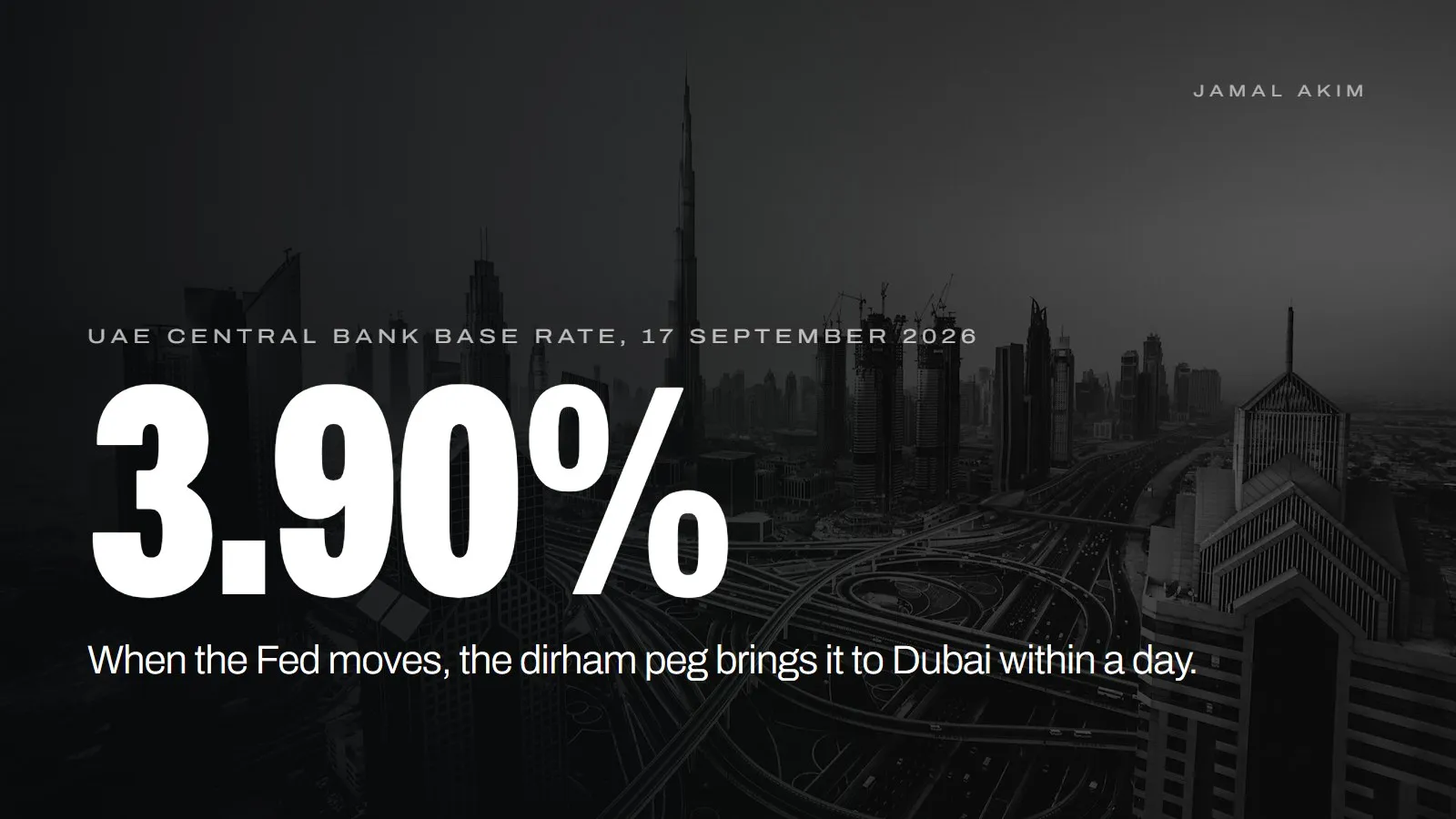
- The Fed raised rates to 3.75% to 4.00% on 16 September 2026. The UAE Central Bank followed on 17 September, moving its Base Rate to 3.90%.
- 3-month EIBOR, the benchmark behind most UAE mortgages, rose from about 3.6% in April 2026 to 4.30% by 5 October 2026.
- Most buyers have not felt it yet. Most Dubai deals are cash, most borrowers are on fixed rates, and some banks still offer fixed rates below EIBOR.
- On a AED 1.6 million loan, 3.89% versus 5.30% is about AED 1,287 a month, and it cuts borrowing power by about 13%.
- The biggest impact is on exit prices at completion, when mortgage buyers become the main buyer pool.
The pipe from Washington to Dubai
The dirham is pegged to the US dollar at 3.6725. It has been since 1997. To keep that peg, the UAE cannot run its own interest rate policy. When the Fed moves, the Central Bank of the UAE moves with it, usually within a day.
So the pipe looks like this:
- The Fed sets the US rate.
- The CBUAE moves its Base Rate to match the Fed’s interest on reserve balances.
- EIBOR, the rate banks lend to each other at in dirhams, follows.
- Your mortgage is priced as EIBOR plus a margin, or as a fixed rate the bank sets with EIBOR in mind.
Here is what actually happened.
| Date | Fed target range | CBUAE Base Rate |
|---|---|---|
| July 2023 (peak) | 5.25% to 5.50% | 5.40% |
| December 2024 | 4.25% to 4.50% | 4.40% |
| December 2025 | 3.50% to 3.75% | 3.65% |
| 17 September 2026 | 3.75% to 4.00% | 3.90% |
- Fed target, upper bound
- CBUAE Base Rate
- 3-month EIBOR
See the numbers
| Year | Fed target, upper bound | CBUAE Base Rate | 3-month EIBOR |
|---|---|---|---|
| Jul 23 | 5.50% | 5.40% | 5.40% |
| Sep 24 | 5% | 4.90% | no data |
| Dec 24 | 4.50% | 4.40% | no data |
| Sep 25 | 4.25% | 4.15% | no data |
| Oct 25 | 4% | 3.90% | no data |
| Dec 25 | 3.75% | 3.65% | no data |
| Apr 26 | 3.75% | 3.65% | 3.60% |
| Sep 26 | 4% | 3.90% | 4.20% |
| Oct 26 | 4% | 3.90% | 4.30% |
EIBOR started rising months before the Fed moved: about 3.6% in April 2026, 4.30% on the 5 October fixing. The 2023 EIBOR point is approximate (it peaked a little above 5.4%).
Source: Federal Reserve; CBUAE via Gulf News; EIBOR fixings via mortgagecompare.ae and mortgease.ae
The Fed cut three times in late 2024 and three more in late 2025. Then in September 2026 it reversed and hiked by 25 basis points, its first increase since July 2023. The CBUAE raised the Base Rate from 3.65% to 3.90% the next morning. Markets were pricing at least one more hike at the time.
So have we felt it?
Here is my honest read: mostly not yet. And there are four reasons why.
1. Most of Dubai buys with cash
It depends what you count, and the split tells you something. Knight Frank found cash buyers made up 87% of all purchases in the first quarter of 2025, a number driven by off-plan, where banks barely lend. By value, AGBI’s reading of Dubai Land Department data put mortgage deals at roughly a quarter of all sales in 2025. Either way, most of the money moving through Dubai does not care what EIBOR does on a Tuesday.
But look at ready homes and it flips. Cavendish Maxwell put the mortgage share of ready unit sales at 61% in 2025. Keep that number in your head. It comes back later.
2. Most borrowers are fixed
The typical UAE mortgage is fixed for one to five years, then reverts to EIBOR plus a margin. If you fixed in 2025, the hike does not touch you until your fix ends. That is a delayed fuse, not no fuse.
3. Banks are still fighting for business
This is the strange one. On the 5 October fixing, 3-month EIBOR was 4.30%. Yet some of the big banks were still advertising fixed rates from around 3.75% to 3.89% for salary transfer customers. That is a fixed rate below the floating benchmark. Banks do that to win market share. It does not last forever.
4. The market moved before the Fed did
3-month EIBOR was around 3.6% in April 2026. By early October it was 4.30%. That is roughly 70 basis points of rise, most of it before the Fed even announced. Variable-rate borrowers have already been paying more for months. They just did not get a headline.
The hike has landed on variable borrowers. It is waiting for fixed borrowers. And it has barely touched cash buyers.
What it does to a real monthly payment
Let me make it real. AED 2 million apartment. Resident buyer. 80% loan, so AED 1.6 million borrowed over 25 years.
| Rate | Monthly payment | Per year |
|---|---|---|
| 3.89% (today’s best fixed offers) | AED 8,349 | AED 100,188 |
| 4.39% | AED 8,794 | AED 105,528 |
| 4.89% | AED 9,251 | AED 111,012 |
| 5.30% (3M EIBOR 4.30% + 1.00% margin) | AED 9,635 | AED 115,620 |
- 3.89%best fixed offers, October 2026AED 8,349
- 4.39%AED 8,794
- 4.89%AED 9,251
- 5.30%3M EIBOR 4.30% + 1.00% marginAED 9,635
The gap between 3.89% and 5.30%: about AED 1,287 a month, or AED 15,440 a year.
See the numbers
| Item | Value |
|---|---|
| 3.89% (best fixed offers, October 2026) | AED 8,349 |
| 4.39% | AED 8,794 |
| 4.89% | AED 9,251 |
| 5.30% (3M EIBOR 4.30% + 1.00% margin) | AED 9,635 |
Standard repayment mortgage, 25 years, payments rounded. Excludes life and property insurance.
Source: Jamal Akim calculation; rates from mortgagecompare.ae, October 2026
The difference between a good fixed deal today and a variable rate at today’s EIBOR is about AED 1,287 a month. Over a year that is more than AED 15,000.
Now flip it around. If a buyer can afford AED 8,349 a month and the rate goes from 3.89% to 5.30%, what they can borrow falls from AED 1.6 million to about AED 1.39 million. That is a 13% cut in buying power from one move in rates.
That number is the one I want you to remember. Not because of your mortgage. Because of the next buyer’s.
Why this matters even if you pay cash
Here is the part nobody explains properly.
A building goes through four phases, and each phase has a different buyer.
The four phases of price appreciation
- 01Off-planInvestorsCash and payment plans
- 02ConstructionInvestorsA small, tight pool
- 03CompletionLeveraged buyersBanks lend; mortgages arrive
- 04MaturityEnd usersBuying a home, not a flip
- Off-plan and construction. Your buyer is another investor. They want margin. Your profit is literally their discount, so they squeeze.
- Completion. The building is real. Banks will now lend on it. A whole new pool arrives: leveraged buyers, people using mortgages.
- Maturity. End users who want to live there, often also with a mortgage, pay for the home, not the spreadsheet.
So who sets your exit price when you sell at completion? The mortgage buyer. Remember that 61% of ready home sales in 2025 used a mortgage. And what decides how much the mortgage buyer can pay? The rate.
If rates drift up another point between now and your handover in 2028, your completion buyer has less to spend. If rates come back down, they have more. That is how a decision in Washington ends up in your profit on a tower in Business Bay.
I go deeper on this in off-plan vs resale: the day-one cash maths.
The completion buyer, worked through
Let me show you what that looks like for one real-world style buyer.
Say your future buyer is a resident couple who can comfortably spend AED 11,000 a month on a mortgage. They have 20% saved, so the bank lends the other 80% over 25 years.
| Their rate | What they can borrow | The price they can pay at 80% |
|---|---|---|
| 3.89% | about AED 2.11 million | about AED 2.64 million |
| 4.89% | about AED 1.90 million | about AED 2.38 million |
| 5.30% | about AED 1.83 million | about AED 2.28 million |
| 5.75% | about AED 1.75 million | about AED 2.19 million |
Same couple. Same salary. Same deposit percentage. The only thing that changed is the rate, and their ceiling moved by more than AED 350,000 between the first line and the third.
Now imagine you bought off-plan at AED 2.4 million and plan to sell at handover. In the first line, this couple can pay your price with room to spare. In the third, they cannot reach it without a bigger deposit. That is not a theory about Washington. That is your exit.
So when I stress test an off-plan deal for a client, I do not just ask what the unit will be worth. I ask who can afford it, at what rate, on the day it completes.
What the hike does to rents and yields
There is a second, slower effect that people miss.
When mortgages get dearer, some would-be buyers stay renters for longer. That supports rents, especially for family homes in established communities where people want to stay. Landlords who own outright feel that as steady demand.
Landlords with variable mortgages feel the other side. If your rent is fixed for the year and your payment rises every quarter with EIBOR, your margin gets squeezed from below. On a well bought unit that is an inconvenience. On a unit bought at a thin yield with a big loan, it is a problem.
My rule is simple. If the deal only works at today’s best fixed rate, it does not work. Run it at one point higher and make sure you can still sleep.
Who feels a Fed hike the most: Dubai, London or New York?
Same decision in Washington. Three very different outcomes.
New York. Most American homeowners hold 30-year fixed mortgages. When rates rise, existing owners barely feel it. What they do instead is stop moving, because nobody wants to give up a cheap loan. Supply freezes and prices stay sticky.
London. The Bank of England sets its own rate. It watches the Fed but it is not tied to it. Most UK mortgages are two to five year fixes, so pain arrives in waves as those fixes end.
Dubai and Abu Dhabi. The UAE imports the Fed’s decision directly through the dollar peg, usually within 24 hours. But because most buyers pay cash and most borrowers fix for a few years, the impact lands first on variable borrowers and on the budgets of new mortgage buyers.
| City | Rate follows the Fed? | Typical mortgage | Who feels a hike first |
|---|---|---|---|
| New York | Yes, it is the Fed | 30-year fixed | New buyers |
| London | No, Bank of England | 2 to 5 year fixed | Owners as fixes end |
| Dubai and Abu Dhabi | Yes, via the peg | 1 to 5 year fixed, then EIBOR | Variable borrowers and new buyers |
That is why I watch the Fed more closely than most London agents do. For us, it is not background noise. It is our interest rate.
Three ways the next year could go
Nobody knows where rates go next, including the Fed. So I plan with scenarios, not predictions.
Scenario one: more hikes. When the Fed moved in September 2026, markets were pricing another quarter point before the end of the year and more into 2027. If that happens, 3-month EIBOR likely pushes towards 4.5% to 4.75%. Fixed offers below 4% disappear. Variable borrowers feel it every month. Completion buyers in 2027 and 2028 can borrow less.
Scenario two: a long hold. The Fed sits at 3.75% to 4% for a year. EIBOR settles around today’s level. Banks keep competing on fixed rates, and the market gets used to it. This is the boring scenario, and boring is fine for property.
Scenario three: back to cuts. If the US economy slows, the Fed reverses again. EIBOR falls, variable payments drop and borrowing power returns. This is the scenario that helps an off-plan seller at completion the most.
- More hikes
- Long hold
- Back to cuts
See the numbers
| Year | More hikes | Long hold | Back to cuts |
|---|---|---|---|
| Oct 26 | 4.30% | 4.30% | 4.30% |
| Q1 27 | 4.45% | 4.30% | 4.10% |
| Q2 27 | 4.60% | 4.30% | 3.90% |
| Q3 27 | 4.70% | 4.30% | 3.70% |
| Q4 27 | 4.75% | 4.30% | 3.50% |
Illustrative scenarios, not a forecast. Nobody knows where rates go next, including the Fed.
Source: Jamal Akim, scenarios built from the 5 October 2026 fixing
You do not need to pick one. You need a plan that survives all three. That means a payment you can afford in scenario one, and an exit price that does not depend on scenario three.
What I would do right now
If you are buying with a mortgage in the next six months:
- Get a pre-approval now, while fixed offers are still competitive.
- Compare the reversion margin, not just the headline fixed rate. A 3.89% fix that reverts to EIBOR plus 1.99% is a very different loan from one that reverts at plus 1.00%.
- Check the early settlement terms. If you might sell or refinance in three years, they matter.
If you are already on a fixed rate:
- Put your fix end date in your calendar now, and start comparing banks three months before it.
If you are buying off-plan with cash:
- Stress test your exit. Ask: if rates are one point higher at handover, what can my completion buyer afford? Price your expectations from that.
If you are a non-resident:
- Your rates and deposit rules are different. Read my non-resident mortgage guide.
The jargon, in plain English
- EIBOR. The Emirates Interbank Offered Rate, published every business day for 1, 3 and 6 month periods. Most UAE variable mortgages are EIBOR plus a margin.
- CBUAE Base Rate. The rate on the Central Bank’s overnight deposit facility. It is anchored to the Fed’s interest on reserve balances.
- Margin. The fixed amount the bank adds on top of EIBOR. This is where banks compete.
- Reversion rate. What your mortgage switches to when the fixed period ends, usually EIBOR plus a margin.
- Loan-to-value (LTV). The loan as a share of the property’s value.
- Debt burden ratio. Your total monthly debt payments as a share of income. Capped at 50% in the UAE.
Where to get your actual numbers
I am a property advisor, not a mortgage adviser. When clients need finance, I introduce them to GCC Mortgages, a RERA-registered, DED-licensed Dubai brokerage that compares 18 plus UAE banks, conventional and Islamic. Pre-approval is typically within 24 hours once they have your documents, and their broker fee is paid by the bank, not by you.
Get your mortgage options and they will tell you what you can borrow before you commit to anything.
My take
Washington has reached Dubai. It arrived quietly, through EIBOR, months before the headline. Cash buyers barely noticed. Variable borrowers already pay more. Fixed borrowers will feel it when their fix ends.
But the real impact is on the exit. Mortgage buyers are the bridge between investors and end users. When rates rise, that bridge gets narrower. Plan for it.
General market commentary, not financial or mortgage advice. Rates and fixings change daily; figures were checked in October 2026 from the Federal Reserve, CBUAE announcements reported by Gulf News, and EIBOR and bank rate data published by UAE mortgage comparison sites. Payment examples are illustrative, use a 25-year term and exclude insurance and fees. I don’t receive a fee from GCC Mortgages for introductions; we work together and refer clients to each other. Financing is arranged and regulated through GCC Mortgages and the lender.
Frequently asked questions
Why does the US Federal Reserve affect UAE mortgage rates?
The dirham is pegged to the US dollar at 3.6725. To hold the peg, the Central Bank of the UAE moves its Base Rate in line with the Fed's interest on reserve balances. EIBOR, the rate most UAE mortgages are priced off, follows.
Did the UAE raise rates in September 2026?
Yes. The Fed raised its target range to 3.75% to 4% on 16 September 2026, its first hike since 2023. The CBUAE raised its Base Rate from 3.65% to 3.90% effective 17 September 2026.
What is 3-month EIBOR today?
3-month EIBOR was 4.30% on the 5 October 2026 fixing, up from roughly 3.6% in April 2026. Check the Central Bank of the UAE for the latest fixing.
Should I fix or go variable after the hike?
If you need certainty on your monthly payment, many buyers are taking 2 to 5 year fixed rates while advertised fixed offers still sit below variable pricing. Look at the reversion margin, early settlement terms and how long you plan to hold before choosing. A broker can compare these side by side.
Sources
- Federal Reserve: FOMC meeting calendar and statements
- Gulf News: UAE Central Bank raises base rate to 3.9% after US Fed rate hike (September 2026)
- Khaleej Times: UAE raises overnight deposit rate after Fed's quarter-point hike
- mortgagecompare.ae: 3-month EIBOR fixings and advertised UAE mortgage rates
- mortgease.ae: EIBOR rate history 2026
- Knight Frank: Dubai Residential Market Review Q1 2025 (cash share of purchases)
- AGBI: Dubai's property boom leans on cash as mortgage lending lags (January 2026)
Considering an investment in Dubai?
Send me your budget, timeframe and objective and I'll give you my view on where I'd start.