
Dubai Rents Are Falling. So Why Isn't Yours?
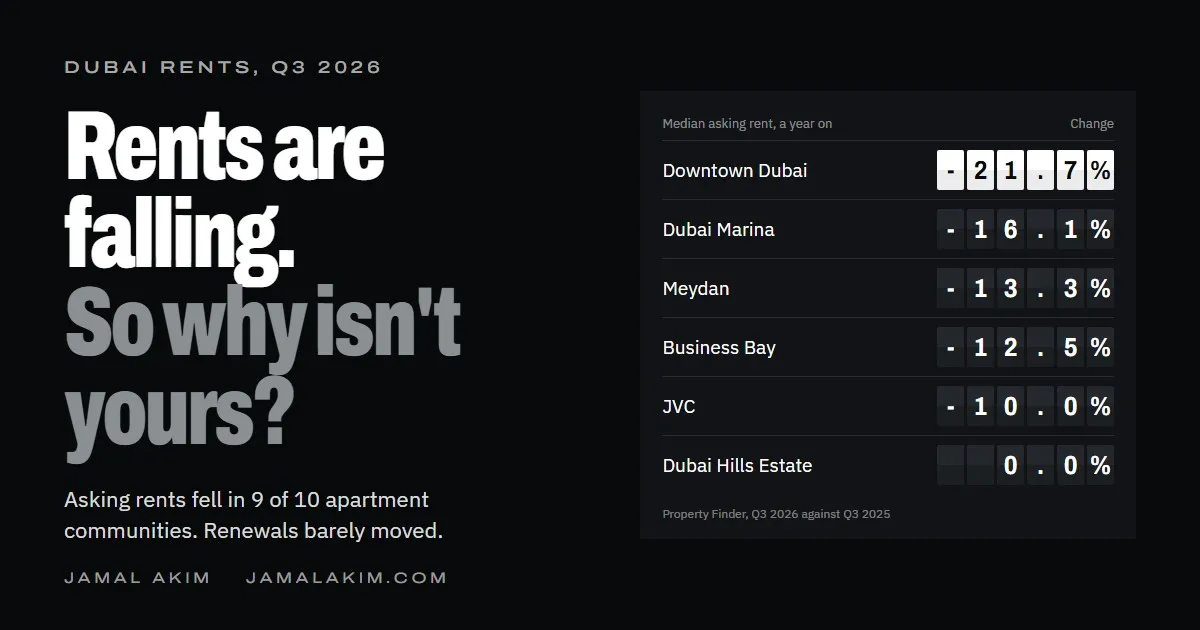
This week Lovin Dubai and Property Finder posted a simple carousel: Dubai rents are cooling down. Asking rents fell in nine of ten apartment communities and eight of ten villa communities against the same quarter last year.
The comments were the best part. “I think I live in another Dubai.” “Does Dubai rent know this?” Someone said Marina rents on Property Finder looked exactly the same as before March. Someone else said their landlord’s answer to any negotiation is still “pay or go.”
Here is the thing. Both sides are right. The data is real, and so is the renewal letter on your kitchen table. They are describing two different Dubais, and once you see why, you know exactly what to do with your next lease.
First, the numbers
These are median asking rents on Property Finder: what landlords advertised in the third quarter of 2026 against the third quarter of 2025. Watch the board.
Median asking rent, AED a year
Q3 2025 against Q3 2026
- Downtown Dubai230,000180,000-21.7%
- Dubai Marina155,000130,000-16.1%
- Meydan74,99965,000-13.3%
- Business Bay120,000105,000-12.5%
- Jumeirah Village Circle79,99971,999-10.0%
- Dubai Creek Harbour160,000145,000-9.4%
- Mohammed Bin Rashid City118,800110,000-7.4%
- Arjan80,00075,000-6.3%
- Palm Jumeirah251,988240,000-4.8%
- Dubai Hills Estate130,000130,0000.0%
- Arabian Ranches 3370,000300,000-18.9%
- Mohammed Bin Rashid City1,000,000850,000-15.0%
- Dubai South199,894175,000-12.4%
- Palm Jumeirah1,677,0001,500,000-10.6%
- Jumeirah Village Circle220,000200,000-9.1%
- Al Barsha490,000450,000-8.2%
- Jumeirah Park395,000380,000-3.8%
- The Springs230,000225,000-2.2%
- Dubai Hills Estate520,000525,000+1.0%
- Al Furjan330,000379,999+15.2%
Downtown fell the furthest, from AED 230,000 to AED 180,000, and Property Finder says the drop held across every apartment size. That matters, because it means it is not just a wave of studios dragging the median down. Marina, Meydan, Business Bay and JVC all fell by double digits.
Look at what did not move, too. Dubai Hills Estate apartments were flat at AED 130,000, and Dubai Hills villas were up by under 1%. That is the same pattern I wrote about in the golden drop and the ripple: places where the value has already landed hold their ground when the market around them softens. Al Furjan’s 15% rise is mostly a mix effect, with more five-bedroom villas listed; three of its five villa types actually fell.
Zoom in: JBR
JBR is not in Property Finder’s ten, but for a lot of people it is the first picture that comes to mind when they think of renting by the beach in Dubai, so I pulled its numbers separately from Bayut, which shows both what JBR flats are listed at and what is actually registered with the Dubai Land Department.
Close-up: Jumeirah Beach Residence (JBR)
−9%
asking rents on JBR listings, last 6 months
−8%
rents registered with the Land Department, last 12 months
1,680
new apartment rental contracts, last 12 months
average asking rent average registered rent, AED a year
Studio
−12%
1 bed
−22%
2 beds
−21%
3 beds
−27%
Registered averages by cluster: Bahar AED 115,240, Rimal AED 146,504, Sadaf AED 163,609.
Averages, not medians. Asking rents cover Bayut listings over six months; registered rents cover Dubai Land Department contracts over twelve, so read the gap as a guide, not an exact discount. Source: Bayut, JBR apartments for rent, read 14 October 2026.
Both measures point the same way. Asking rents on JBR listings are down 9% over six months, and the rents registered with the Land Department are down 8% over the year. That is gentler than Dubai Marina next door, where Property Finder’s asking median fell 16%, but the direction is the same.
The bigger story is the gap. A one-bedroom in JBR is listed at about AED 142,600 on average. The average rent actually registered for one is about AED 111,200, roughly 22% lower. For two-bedroom flats the gap is about 21%, for three-bedroom flats about 27%, and studios are closer at about 12%. Part of that is negotiation, because people sign below the asking price. Part of it is likely the register taking in tenants on older rents that were held down at renewal. Either way, if you are renting in JBR, the listing price is where the conversation starts, not where it ends.
Why: Dubai built a lot of homes, fast
This is not a mystery and it is not a crash. It is supply.
Cavendish Maxwell counted about 24,800 new homes completed in the first half of 2026, the most in years, and Savills counted roughly 27,300 handed over in the second quarter alone. Every one of those keys either goes to someone moving in or onto a listing site. I looked at whether that becomes a long-term glut in Dubai’s 2028 oversupply question. The short version: people are still arriving, but this year the homes arrived faster.
You can see it in the room. In September the number of apartments advertised for rent each day on Property Finder was up 55.1% on a year earlier. People enquiring were up 15.4%. Demand did not fall. It just got outnumbered.
a share of renters enquiring a home listed with nobody to match it
September 2025100 listed, 100 enquiring
September 2026155 listed, 115 enquiring
−23%
enquiries for each apartment listing, September 2026 against a year earlier. Listings up 55.1%, enquiries up 15.4%.
Index, September 2025 = 100. Average daily apartments advertised for rent and renter enquiries on Property Finder. Source: Property Finder via Arabian Business.
When each listing gets nearly a quarter fewer enquiries, a landlord with an empty flat feels it within weeks. That landlord lowers the price. That is the Dubai in the Instagram post.
So why hasn’t your rent moved?
Because you are not in that Dubai. You are in the renewal one.
Same building, same unit type. Change in rent since January 2026.
The Dubai on the listing sites
−15.3%
New leases. What you pay if you move.
The Dubai in your renewal letter
−1%
Renewals. What you pay if you stay.
fäm Properties went through Dubai Land Department lease registrations and compared like with like: same building, same unit type. Since January, rents on new leases are down 15.3%. Rents on renewals are down about 1%.
That gap is not landlords being stubborn. It is the system working the way it was built. Dubai’s rent rule, Decree No. 43 of 2013, decides how much a landlord can add at renewal, based on how far your rent sits below the average for similar units. During the run-up, it kept a lot of sitting tenants well below market. Now the market has come back down towards them, and the rule has nothing to say about cuts. A lower rent at renewal is not automatic. It is a conversation.
The people in the comments saying “not in my Dubai” are mostly people who have stayed put. The people quietly paying less are the ones who moved, and this summer, for the first time on record, there were more of them.
Each tick is a month of lease registrations. Below the line: more renewals than new leases. Above it: more new leases.
New leases minus renewals, Dubai Land Department registrations, analysed by fäm Properties. Source: Khaleej Times.
In July new leases beat renewals by 633 contracts. In August, by 2,139. Renewals had led every month since the dataset began in January 2023. The switching was heaviest in JVC, Business Bay, Marina and Downtown. In lower-cost districts like International City, Jebel Ali and Dubai Silicon Oasis, renewals still led, which makes sense: when rents are already tight, there is less room to fall.
Is this the bottom?
Honestly, nobody knows yet, and I would be careful with anyone who says they do.
Combined median apartment asking rent across the ten communities, AED a year
Property Finder said the September uptick and better enquiries per listing are early signs of stabilising, and cautioned that one month is not enough. Source: Property Finder via Arabian Business.
Across Property Finder’s ten apartment communities, the combined median asking rent went from AED 135,000 in December 2025 to AED 100,000 by June. In September it ticked back up to AED 105,000 and enquiries per listing improved. Property Finder itself says one month is not a trend. More homes are still due to be handed over this year, so I would plan for a market that stays soft in new, apartment-heavy communities and holds up in established ones.
Two other things to keep in mind before you quote this article at your landlord. These are asking rents, not signed ones, so the real deals can land above or below them. And a median for a whole community mixes studios with three-bedroom flats, so your building can behave very differently from the headline.
If you rent: what I would do this month
Start with your own numbers. Put your rent and the index average for your unit into the box below; you get the index figure from the Dubai Land Department’s free Rental Index calculator.
Two minutes, your figures only. Nothing you type leaves this page.
Enter your rent and the index average to see the most your landlord can add.
Bands from Decree No. 43 of 2013: no increase if your rent is up to 10% below the average for similar units, 5% if 11 to 20% below, 10% if 21 to 30% below, 15% if 31 to 40% below, 20% if more than 40% below. Any increase also needs written notice at least 90 days before the lease ends. The decree caps increases; it does not order cuts, so a lower rent at renewal is a negotiation. The DLD calculator gives the official answer for your unit. This is a guide, not legal advice.
Then, in plain terms:
- Check the 90 days. Any increase needs written notice at least 90 days before your lease ends. No notice, no increase.
- Get one real quote. Find a comparable home in your community and ask what it actually rents for. That number is worth more than any headline, including this one.
- Take it to your landlord before you take it anywhere else. A landlord facing an empty unit, agent fees and weeks without rent will often match a fair number to keep a good tenant. fäm saw exactly that: the landlords who adjusted kept their tenants.
- Count the cost of moving honestly. Agency fee, deposits, connections, movers, a weekend of your life. If the first year’s saving does not cover it, use the quote to negotiate and stay.
If you own: the market has changed seats
I spend most of my time with investors, so let me be just as direct with you. Pricing to what the flat rented for last year is how units sit empty this year. A month without a tenant costs you a twelfth of your annual rent, about 8.3%. A modest cut that fills the unit in a week is almost always cheaper than holding out for a price the market has already left.
Property Finder’s own advice to landlords was that price alone may not be enough: the quality of the listing, how visible it is and how fast you reply now decide who gets the tenant. I would add flexibility. More cheques, or monthly payments where you can offer them, widen the pool of people who can say yes. And if your tenant is good, pick up the phone before the renewal date. Keeping them at a fair rent beats finding a new one at the same rent.
For buyers, softer rents are not a reason to panic. They are a reason to underwrite properly: use today’s rents, not last year’s, when you work out a yield, and favour the communities that held their ground. That is where I would be looking.
The Dubai that is real
So, is Dubai cooling? For anyone signing a new lease, yes, clearly. For anyone renewing, barely, and the rules explain why. The gap between those two Dubais is where the money is this year.
If you are the person in the comments whose rent just went up, send me your renewal letter and your building. I will tell you honestly where the market is for your unit, and whether to stay, push back or move.
Frequently asked questions
Are rents falling in Dubai?
Asking rents are. Property Finder data showed median asking rents falling in 9 of 10 popular apartment communities between Q3 2025 and Q3 2026, with Downtown down from AED 230,000 to AED 180,000. Dubai Hills Estate apartments were flat.
Why hasn't my Dubai rent gone down at renewal?
Because renewals and new leases move differently. fäm Properties' analysis of DLD registrations found new-lease rents down 15.3% since January against about 1% for renewals. Dubai's rent rule, Decree No. 43 of 2013, limits increases at renewal but says nothing about cuts, so a lower rent is a negotiation.
How much notice does a Dubai landlord need to give for a rent increase?
Written notice at least 90 days before the lease ends. Without it, there is no increase.
Why are Dubai asking rents falling?
A wave of new homes. Cavendish Maxwell counted about 24,800 completed in the first half of 2026, and daily apartment listings for rent on Property Finder were up 55.1% year on year in September while enquiries rose 15.4%. Demand did not fall; it was outnumbered.
What should Dubai landlords do when rents fall?
Price to today's market, not last year's rent. A month empty costs about 8.3% of the annual rent, so a modest cut that fills the unit quickly is usually cheaper. Flexible payments and keeping good tenants also help.
Sources
- Arabian Business: Dubai asking rents fall up to 22% across popular areas as property listings surge 55% (Property Finder data, 12 October 2026)
- Lovin Dubai with Property Finder: Dubai rents are cooling down (Instagram, October 2026)
- Khaleej Times: Dubai tenants move homes as new leases offer rents up to 15% lower (fäm Properties analysis of DLD data, 23 September 2026)
- Dubai Legislation Portal: Decree No. 43 of 2013 Determining Rent Increase for Real Property
- Dubai Land Department: Rental Index calculator
- Gulf News: landlords must give 90 days' notice of a rent increase, even under the Smart Rental Index
- Bayut: apartments for rent in Jumeirah Beach Residence (listing and DLD rent data, read 14 October 2026)
- Khaleej Times: Dubai delivers record 24,800 new homes in H1 2026 (Cavendish Maxwell)
- Savills: Dubai residential market moderates amid higher handovers in Q2 2026
Considering an investment in Dubai?
Send me your budget, timeframe and objective and I'll give you my view on where I'd start.