
Rates went up. Dubai borrowed more than ever. Here's why
Rates went up in September. Sales slowed. Prices dipped for the first time in years.
And Dubai took out more home loans than ever.
That sounds like a contradiction. It isn’t. Once you see who is borrowing and why, it tells you a lot about where the market is, and what to do if you’re buying now.
Key takeaways
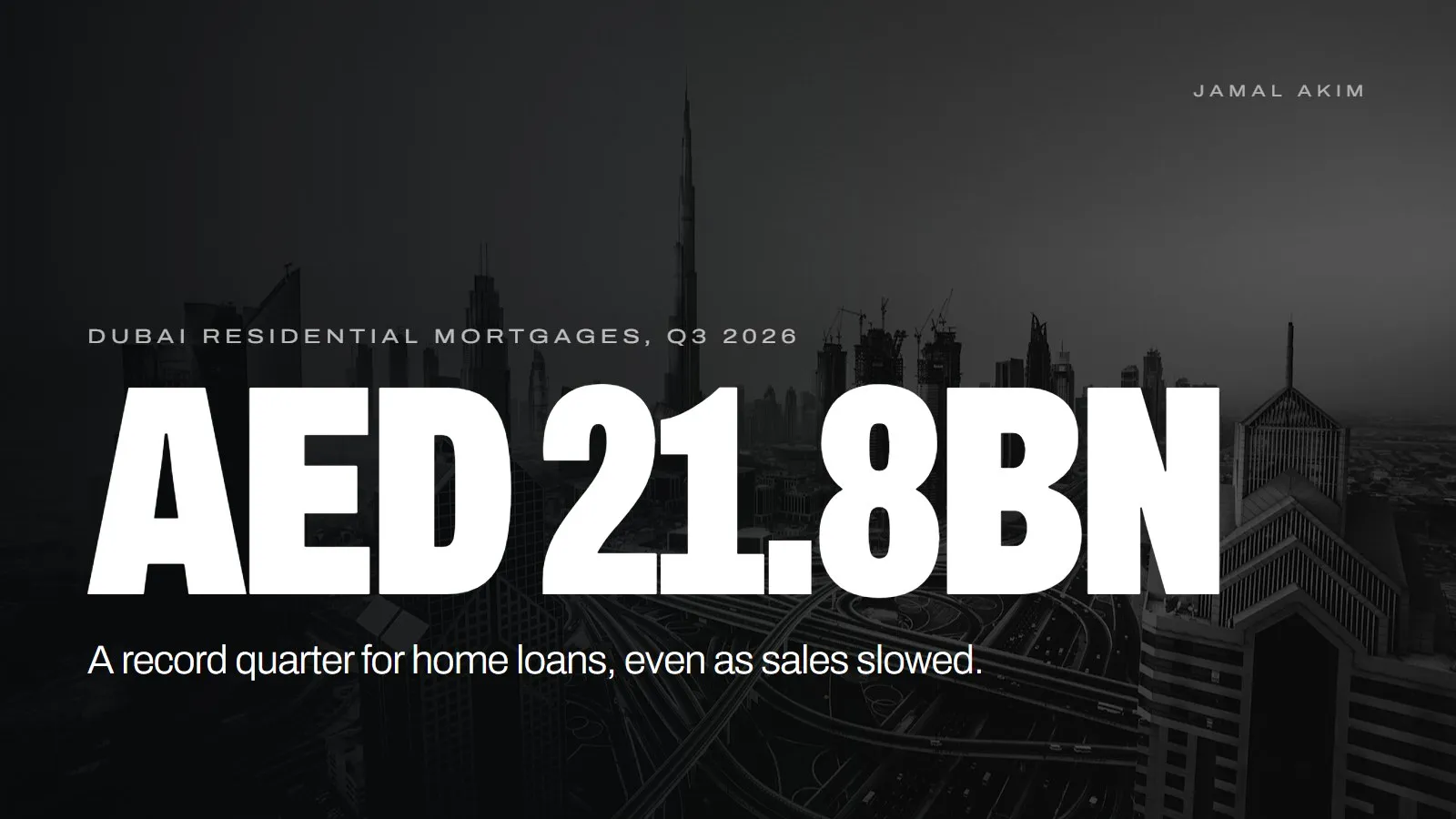
- Dubai residential mortgages hit a record AED 21.8 billion in Q3 2026, about 10,000 loans (Cavendish Maxwell, via Arabian Business).
- That beat the previous record of AED 20.5 billion, set in Q4 2025. Mortgage volumes rose almost 33% on the quarter.
- It happened while residential sales value fell about 47% year on year and average prices slipped 2.2%.
- The fuel was handovers, refinancing and mortgage-funded purchases. Not a buying frenzy.
- Fixed rates still start around 3.75% for strong applicants, even after the UAE base rate rose to 3.90%.
The numbers
Residential mortgages, Q3 2026
AED 21.8bn
about 10,000 loans, a quarterly record
Previous record, Q4 2025
AED 20.5bn
Mortgage volumes vs Q2
+33%
Now put that next to the rest of the market in the same quarter:
| Q3 2026 | Change |
|---|---|
| Residential sales, about 33,900 deals worth AED 72.6bn | Value down about 47% year on year |
| Average price, AED 1,644 per sq ft (September) | Down 2.2% year on year, up 0.3% on the quarter |
| Villa and townhouse mortgages | Up 40% on the quarter |
| Apartment mortgages | Up about 30% on the quarter |
Fewer sales. More borrowing. So who is borrowing?
Who is actually taking these loans
1. Off-plan buyers at handover. The boom years of 2022 to 2024 sold tens of thousands of off-plan homes. Those are completing now. Cavendish Maxwell counts 38,000 homes delivered in the first nine months of 2026, up 41%, with another 24,000 due before December. Many of those buyers owe 30% to 60% at handover, and most were always going to mortgage it. That is exactly what a handover mortgage is for.
2. Owners refinancing. Anyone who fixed two or three years ago is coming off that deal. Banks are competing hard for those borrowers. Mortgage broker Lomond told Khaleej Times that banks are competing for business, especially refinancing and buyouts. I cover when that’s worth doing in my refinancing guide.
3. People buying ready homes to live in. Betterhomes reported that 56% of its residential sales in Q3 were mortgage-backed. That’s down from 64% in Q2 as more cash buyers came in, but still more than half.
Cavendish Maxwell made the same point itself: the record does not necessarily mean stronger demand from new buyers, because handovers and refinancing are part of it. That’s the honest read.
But didn’t rates go up?
They did, a little. The Central Bank of the UAE raised its Base Rate from 3.65% to 3.90% on 17 September 2026 and held it on 28 October.
Here’s why borrowers kept going:
- Fixed rates barely moved. GCC Mortgages’ November rate table shows 1-year fixed rates from 3.75%, 3-year fixed from 3.99% and 5-year fixed from 4.19% for salaried applicants with salary transfer. See the current UAE mortgage rates.
- Payments are lower than two years ago. Khaleej Times worked an example: on a AED 1.6 million loan over 25 years, the monthly payment fell from about AED 10,604 at 6.30% in early 2024 to about AED 9,113 at 4.74% in Q2 2026.
- A handover payment has to be paid. If you owe the developer 50% at completion, you either pay cash or borrow. Rates don’t change that.
AED 1.6m over 25 years, early 2024
at 6.30%
AED 10,604 / month
Same loan, Q2 2026
at 4.74%
AED 9,113 / month
about AED 17,900 a year less
What this means if you’re buying now
More homes, more choice. With supply arriving, buyers have more negotiating room than they’ve had in years. A mortgage-ready buyer with a pre-approval letter is a stronger buyer.
Get your number before you view. Salaried UAE residents can start an instant pre-approval in about a minute. I explain how it works in my pre-approval guide.
If you have a handover coming, start early. Banks value the property fresh at completion, not at your off-plan price. If the valuation comes in low, you cover the gap. I break that down in my guide to 20/80 and post-handover plans.
Know the full cost. A mortgage adds its own fees on top of the 4% DLD fee. Here is every fee before the keys.
Cash or mortgage: how Dubai actually buys
You’ll see very different numbers quoted for how many Dubai buyers use a mortgage. They’re all right. They just measure different things.
| Source | What it measured | Mortgage share |
|---|---|---|
| Hamptons, December 2025 | All residential transactions | About 17% (83% cash) |
| Hamptons, March 2026 | All residential transactions | About 24% (76% cash) |
| Reidin, August 2026 | Ready residential purchases only | About 47% |
| Betterhomes, Q3 2026 | Betterhomes’ own residential sales | 56% |
All four as reported by Khaleej Times on 2 November 2026.
The gap is off-plan. Engel and Völkers put off-plan at about 71% of Dubai’s residential sales in the first half of 2026, and off-plan buyers usually pay the developer directly during construction, with no bank involved. So across the whole market, cash looks dominant. But when you look at ready homes, where a bank can lend, close to half of buyers use a mortgage, and in some brokerages more than half.
That matters for you because it tells you who you’re competing with. On a ready home, you’re often up against another mortgage buyer, not a cash buyer. Being pre-approved puts you level.
Villas led the borrowing
Inside the record, villas and townhouses grew fastest. Cavendish Maxwell reported villa and townhouse mortgage transactions up 40% on the quarter and almost 14% on the year. Apartment mortgages rose about 30% on the quarter but were 3.5% lower than a year earlier.
My reading: families buying space to live in are borrowing, because a villa is usually an end-user purchase with a long hold. Apartment investors, who lean more on cash and off-plan plans, are more cautious. If you’re buying an apartment to rent out, that’s useful context: there’s less competition from other leveraged investors right now, and more room to negotiate.
What the supply wave means for borrowers
Cavendish Maxwell estimates about 291,800 homes are due to complete in Dubai across 2027 and 2028: 136,100 next year and 155,700 the year after. Dubai has already delivered 38,000 homes in the first nine months of 2026, up 41% on the same period last year.
Three things follow for anyone borrowing:
- Banks will value carefully. Central Bank rules already say valuations can’t include expected future price growth. With more stock arriving, valuers will lean on recent comparable sales, not asking prices.
- Handover valuations are the pressure point. If you bought off-plan at a launch premium, the bank’s handover valuation may be lower than your price. Here’s how to plan for that.
- Buyers have leverage. More completed homes means more choice. A buyer with finance arranged can negotiate harder on price, which also cuts the 4% DLD fee you pay on it.
How much residents and non-residents can borrow
The Central Bank sets the maximum loan-to-value for every bank in the UAE:
| Buyer | Property | Maximum loan |
|---|---|---|
| Expat, first home | Up to AED 5 million | 80% |
| Expat, first home | Above AED 5 million | 70% |
| Expat | Second home or investment | 60% |
| UAE national, first home | Up to AED 5 million | 85% |
| UAE national, first home | Above AED 5 million | 75% |
| UAE national | Second home or investment | 65% |
| Anyone | Off-plan, before completion | 50% |
Banks can lend less, and usually do for non-residents. GCC Mortgages lists non-resident rates from 4.79% and loans of up to 65% for some lenders. Here’s my non-resident guide if you’re buying from abroad.
If you’re buying in the next three months
- Get pre-approved first. It takes minutes for many salaried residents. Here’s how it works.
- Budget the full cost. Deposit plus about 7.5% in fees on a resale. Every fee, itemised.
- Decide fixed or variable before you sign the offer. How to choose.
- Use the market. More supply and slower sales give you room on price. Ask.
- If you already own, check when your fixed rate ends. Refinancing is part of what drove this record, and banks are competing for it. When a switch pays.
What the record doesn’t tell you
It’s easy to read “record mortgages” as “booming market”. The same data says something more balanced.
- Sales are down. DLD data cited by Arabian Business shows about 122,900 property sales worth AED 378.6 billion in the first nine months of 2026, with sales value down 23.5% on the same period of 2025. September alone was down 45.6% year on year.
- Prices have paused. Cavendish Maxwell recorded the first annual decline in average residential prices since the post-pandemic recovery began, down 2.2% to AED 1,644 per square foot, though up 0.3% on the quarter.
- 2025 was exceptional. Dubai recorded more than 270,000 real estate transactions worth AED 917 billion in 2025. Almost any comparison with it looks weaker.
So the market is slowing from a record year, while bank lending keeps growing because of handovers and refinancing. For a buyer, that combination is usually a better time to negotiate than a frenzy is.
Planning for rates you can’t predict
Nobody knows where rates go next, me included. What you can control is whether a rise would hurt you.
The Central Bank already makes banks stress-test your payment at 2 to 4 points above the current rate. Do the same at home: take the payment at today’s rate, add 2 points, and ask whether you’d still be comfortable. If not, borrow less or fix for longer. Here’s how fixed and variable compare.
Glossary
- Loan-to-value (LTV): the loan as a percentage of the property’s value. An 80% LTV means a 20% deposit.
- Base Rate: the Central Bank of the UAE’s policy rate, which moves with the US Federal Reserve. 3.90% since 17 September 2026.
- EIBOR: the Emirates Interbank Offered Rate. Variable mortgages are priced as EIBOR plus a margin.
- Handover: completion of an off-plan property, when the final payment is due and keys are released.
- Buyout: a new bank paying off your existing mortgage so you continue with the new bank.
- Valuation: the bank’s independent assessment of the property’s value. It lends on the lower of value and price.
My take
The record isn’t a sign the market is overheating. It’s a sign it’s maturing.
For years Dubai ran on cash and developer payment plans. Now more of it runs on bank finance, the way established property markets do. That brings discipline: banks value properties properly, check incomes and stress-test payments. For buyers who plan properly, that’s a good thing.
If you want to know what you can borrow, send me three answers and I’ll connect you with GCC Mortgages, who compare 18+ UAE banks.
General market commentary, not financial or mortgage advice. Figures as reported by the sources listed, checked on 2 November 2026; rates change often and depend on your profile. I don’t receive a fee from GCC Mortgages for introductions; we work together and refer clients to each other.
Frequently asked questions
Did Dubai mortgages really hit a record in 2026?
Yes. Cavendish Maxwell reported a record AED 21.8 billion of residential mortgages in Q3 2026, about 10,000 loans, beating the previous quarterly record of AED 20.5 billion set in Q4 2025.
Why are people still taking mortgages when rates went up?
Three reasons: tens of thousands of off-plan homes are handing over and buyers are financing the final payment, owners are refinancing to better deals, and fixed rates from around 3.75% are still on offer to strong applicants.
Are most Dubai buyers paying cash or using a mortgage?
It depends on the segment. Betterhomes put mortgage-backed purchases at 56% of its residential sales in Q3 2026. Across the whole market, cash dominates because most off-plan purchases are paid through developer plans.
What is the UAE base rate now?
The Central Bank of the UAE raised its Base Rate from 3.65% to 3.90% on 17 September 2026 and held it on 28 October 2026.
Sources
- Arabian Business: Dubai real estate mortgages hit record $5.94bn as buyers secure 10,000 loans (Cavendish Maxwell data, 2 November 2026)
- Khaleej Times: More Dubai homebuyers paying cash as interest rates rise, but mortgages still fund most deals (2 November 2026)
- GCC Mortgages: UAE mortgage rates, November 2026
- GCC Mortgages: Handover mortgage Dubai
- Central Bank of the UAE Rulebook: Regulations Regarding Mortgage Loans
Considering an investment in Dubai?
Send me your budget, timeframe and objective and I'll give you my view on where I'd start.