
UAE VAT Rules From 1 October 2026: Check Your Suppliers or Lose Your VAT Refund
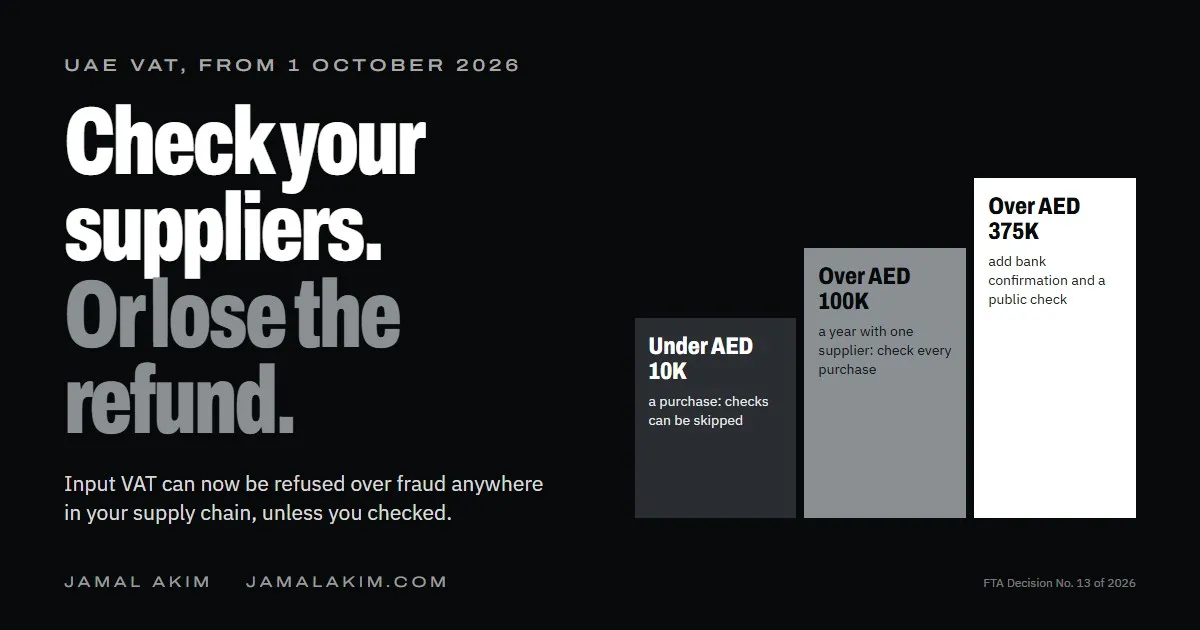
Most people saw the headline and scrolled past. “New UAE business rules starting October 1.” Another compliance update, another thing for the accountant.
Read it properly, though, and one sentence should stop any business owner or property investor with a company: from 1 October 2026, you can lose your VAT refund because of something someone else did in your supply chain. Not you. Someone you bought from, or someone they bought from.
I spend my days with investors buying property in the UAE, many of them through companies, and plenty of them buying commercial units where 5% VAT is real money. So here is what changed, in plain English, what it means for property, and a checklist you can hand to whoever does your books.
What changed in UAE VAT on 1 October 2026
The legal hook is Article 54 bis of the UAE VAT Law, added in the amendments the Ministry of Finance announced for 2026. It says the Federal Tax Authority can refuse an input VAT deduction where a supply, or the chain of supplies behind it, is linked to tax evasion, and the business knew or should have known.
The new part is how “should have known” is decided. FTA Decision No. 13 of 2026, issued on 22 July 2026 and in force from 1 October, sets out the checks a business must do before it reclaims VAT. If you did not do them, you are treated as having known. In other words, the burden has moved onto you to show you checked.
Before this, if you had a valid tax invoice from a registered supplier, you could usually reclaim the VAT. That is no longer enough on its own. You now need the invoice, plus evidence that the supplier and the deal were genuine.
The three numbers: AED 10,000, AED 100,000 and AED 375,000
The rules scale with how much you spend with each supplier. This is the part worth pinning to the wall.
By what you spend with that one supplier over 12 months (the last 12, or the next 12 if you expect to pass the line)
Up to AED 100,000 a year
Small purchases can skip the checks
Any single purchase under AED 10,000 (before VAT) is exempt from the verification steps. Larger purchases from the same supplier still need them.
AED 100,000 to 375,000 a year
Check everything you buy
Once a supplier passes AED 100,000 in 12 months, the small-purchase exemption falls away. Every purchase needs the standard checks on the supplier and the deal.
Over AED 375,000 a year
Add the enhanced checks
On top of the standard checks: get written confirmation of the supplier’s bank account and review public information about them, such as reviews and news coverage.
The AED 375,000 line is the same figure as the UAE's mandatory VAT registration threshold, so many finance teams already track it.
Source: FTA Decision No. 13 of 2026, in force from 1 October 2026, as summarised by EY; the decision is listed on the Federal Tax Authority's legislation page.
- AED 10,000: a single purchase under AED 10,000 before VAT can skip the verification steps. Coffee supplies, small repairs, one-off services.
- AED 100,000: that exemption only holds while your total spend with the supplier stays under AED 100,000 over 12 months (or is expected to). Cross it and every purchase from them needs checking, however small.
- AED 375,000: above this, you add enhanced checks. You must get written confirmation of the supplier’s bank account and look at public information about them, such as customer reviews and media coverage.
The 12 months can look backwards or forwards. If you have just signed a contract that will take you over a line next year, the checks apply now.
What “checking a supplier” actually means
The checks fall into two groups: the supplier, and the deal itself.
The supplier. Confirm who they are: identity documents for an individual, incorporation details for a company. Confirm the people you deal with are allowed to act for them. Check that their business location exists and fits what they do. And look for warning signs, such as a supplier that keeps changing address or management, or deals that do not match their usual business.
The deal. There should be a genuine business reason for the purchase. The price should be in line with the market. What you buy should fall within the supplier’s licensed activities, and goods should be genuine with a clear origin. Payment terms should make commercial sense.
Three payment patterns get special attention: cash, payments to a third party, and payments to a foreign bank account. None is banned, but each now needs a written commercial reason. If a supplier asks you to pay a different company, or an account abroad, that is exactly the moment to ask why and write the answer down.
Finally, keep the evidence and write down who is responsible. The decision expects documented procedures and a policy naming who carries out, reviews and signs off the checks. If the Federal Tax Authority asks, “we checked” is not enough. You need to show it.
A separate change on cash payments
Alongside this, Cabinet Decision No. 149 of 2026 amended the VAT Executive Regulation. Among other changes, it lets the Minister of Finance set a cash threshold above which input VAT cannot be recovered when a supply is paid, or intended to be paid, in cash. Most of the amendments took effect from 1 October 2026.
At the time of writing, the actual cash threshold had not been published. Until it is, my advice is simple: for anything significant, pay by bank transfer to the supplier’s own UAE account, and keep the trail.
What the new VAT rules mean for property owners and investors
Here is where it gets specific to my world.
| Who you are | How much this affects you |
|---|---|
| Individual owning a home or renting one out | Little directly. Residential rent and resale homes are generally VAT exempt, so most residential landlords are not VAT registered. |
| Buyer of a commercial unit through a VAT-registered company | A lot. Commercial property carries 5% VAT, which you usually reclaim. That claim now needs the checks on the seller. |
| Commercial landlord | Yes. You reclaim VAT on maintenance, fit-out, facilities and management costs, so those suppliers need checking. |
| Owner holding property in a UAE company | Yes, if the company is VAT registered and reclaims input VAT on its costs. |
| Developers, agencies and property managers | Yes. Contractors, marketing, portals and service providers all sit in the supply chain. |
Buying a commercial unit. Take a AED 3 million office or retail unit. The 5% VAT is AED 150,000, and a VAT-registered buyer normally reclaims it. That purchase is far above AED 375,000, so before reclaiming, the buyer should verify the seller’s identity and licence, get written confirmation of the bank account the money goes to, review public information about the seller, and keep all of it on file. In practice, a good conveyancer and tax agent will build this into the transaction. Ask them to, in writing, before you transfer funds.
Fit-out and maintenance. If you are fitting out a commercial unit, the contractor bill can easily pass AED 375,000. Same rules: verified contractor, confirmed bank account, written reasons for any unusual payment arrangement.
Holding property through a company. I have written about why a UAE company is not automatically outside UK tax in UAE property companies and UK tax residence. The same discipline applies here: if your company is VAT registered, its paperwork now has to show who it paid and why, not just the invoice.
If you are buying for the first time, the first-time buyer guide sets out the fees on a residential purchase, and my fees page shows what you pay and when.
Is this the UAE getting stricter on business?
Some of the comments under the original post said so, and I understand the reaction. More paperwork is never welcome, especially for small businesses.
But step back and look at what the rules actually target: fake suppliers, invoices for goods that never existed, and money routed through third parties to hide where it went. That is how VAT fraud works everywhere, and Europe and the UK have had similar “knew or should have known” rules for years.
For honest businesses, the cost is a better supplier file. For the country, it protects the tax base that pays for the roads, the rail and the infrastructure that make UAE property worth owning. I would rather invest in a market that closes loopholes than one that leaves them open. It is the same reason I care about the digital changes at the Dubai Land Department: clean records make a stronger market.
Your supplier checklist
Use this before you reclaim input VAT on any significant purchase. Tick as you go, or print it for your accountant.
From 1 October 2026. Tick as you go. 0 of 14 done.
Summarised from FTA Decision No. 13 of 2026. A guide for property owners and small businesses, not tax advice: confirm your process with your accountant or tax agent.
What I would do this week
- List your suppliers by annual spend. Mark anyone over AED 100,000 and anyone over AED 375,000. That is your priority list.
- Ask the big ones for documents now. Trade licence, authorised signatory, and a bank letter confirming the account you pay. Most will have them ready.
- Stop paying third parties or foreign accounts without a written reason. If a supplier asks, get it in writing.
- Move significant cash payments to bank transfers until the cash threshold is published.
- If you are buying commercial property, ask your conveyancer and tax agent to confirm the seller checks are part of the deal before money moves.
None of this is complicated. It is just the paperwork catching up with good practice. Do it once, set a reminder to refresh it, and your VAT refunds stay safe.
If you are weighing a commercial purchase or buying through a company and want to talk through the structure and the numbers, book a call. I am not a tax adviser, and I will always tell you to confirm the tax position with one, but I can make sure the property side is right and the right questions get asked. People first, numbers always.
Frequently asked questions
What are the new UAE VAT rules from 1 October 2026?
Under FTA Decision No. 13 of 2026, a VAT-registered business must check its suppliers and the purchases themselves before it reclaims input VAT. If a supply chain turns out to be linked to tax evasion and the business did not do those checks, the Federal Tax Authority can deny the VAT refund, even if the business itself did nothing wrong.
What are the AED 10,000, AED 100,000 and AED 375,000 thresholds?
Single purchases under AED 10,000 before VAT can skip the checks, unless you spend more than AED 100,000 with that supplier over 12 months, in which case every purchase needs checking. Once you spend more than AED 375,000 with a supplier over 12 months, you must also get written confirmation of their bank account and review public information about them, such as reviews and news coverage.
Do the new VAT supplier checks affect residential landlords in Dubai?
Mostly not directly. Residential rents and resale homes are generally exempt from VAT, so most individual residential landlords are not VAT registered and do not reclaim input VAT. The rules matter if you own property through a VAT-registered company, hold commercial property, or run a business that buys services such as fit-out, maintenance or marketing.
Does this change anything when buying commercial property in the UAE?
It can. Commercial property is subject to 5% VAT, which a VAT-registered buyer usually reclaims. A commercial purchase will almost always be above AED 375,000, so before reclaiming that VAT the buyer should verify the seller's identity and licence, confirm the bank account in writing, check public information and keep the evidence. Ask your tax agent to confirm the process for your purchase.
Are cash payments still allowed under UAE VAT rules?
Yes, but they need a documented business reason. Separately, Cabinet Decision No. 149 of 2026 lets the Minister of Finance set a cash limit above which input VAT cannot be recovered. The threshold had not been published when this article was written, so check before paying large amounts in cash.
What happens if I do not check my suppliers?
If a supply you claimed VAT on is later linked to tax evasion anywhere in the chain, the Federal Tax Authority can treat you as having known about it because you did not verify, and refuse the input VAT. That is a refusal of the refund, which on a large purchase can be a significant cost.
Sources
- Federal Tax Authority: legislation (Decision No. 13 of 2026 on verification of the validity and integrity of supplies)
- EY: UAE issues decision introducing due diligence requirements for input VAT recovery
- Crowe: FTA Decision No. 13 of 2026
- Ministry of Finance: amendments to the VAT Executive Regulation (Cabinet Decision No. 149 of 2026)
- KPMG: Cabinet Decision No. 149 of 2026 amending the VAT Executive Regulation
- Ministry of Finance: VAT law amendments from January 2026 (input tax and evasion arrangements)
- Locals Dubai: New UAE business rules starting October 1 (Instagram)
Considering an investment in Dubai?
Send me your budget, timeframe and objective and I'll give you my view on where I'd start.