
The Roads That Shape UAE Property: E Roads, D Roads and the Highway That Built a Country
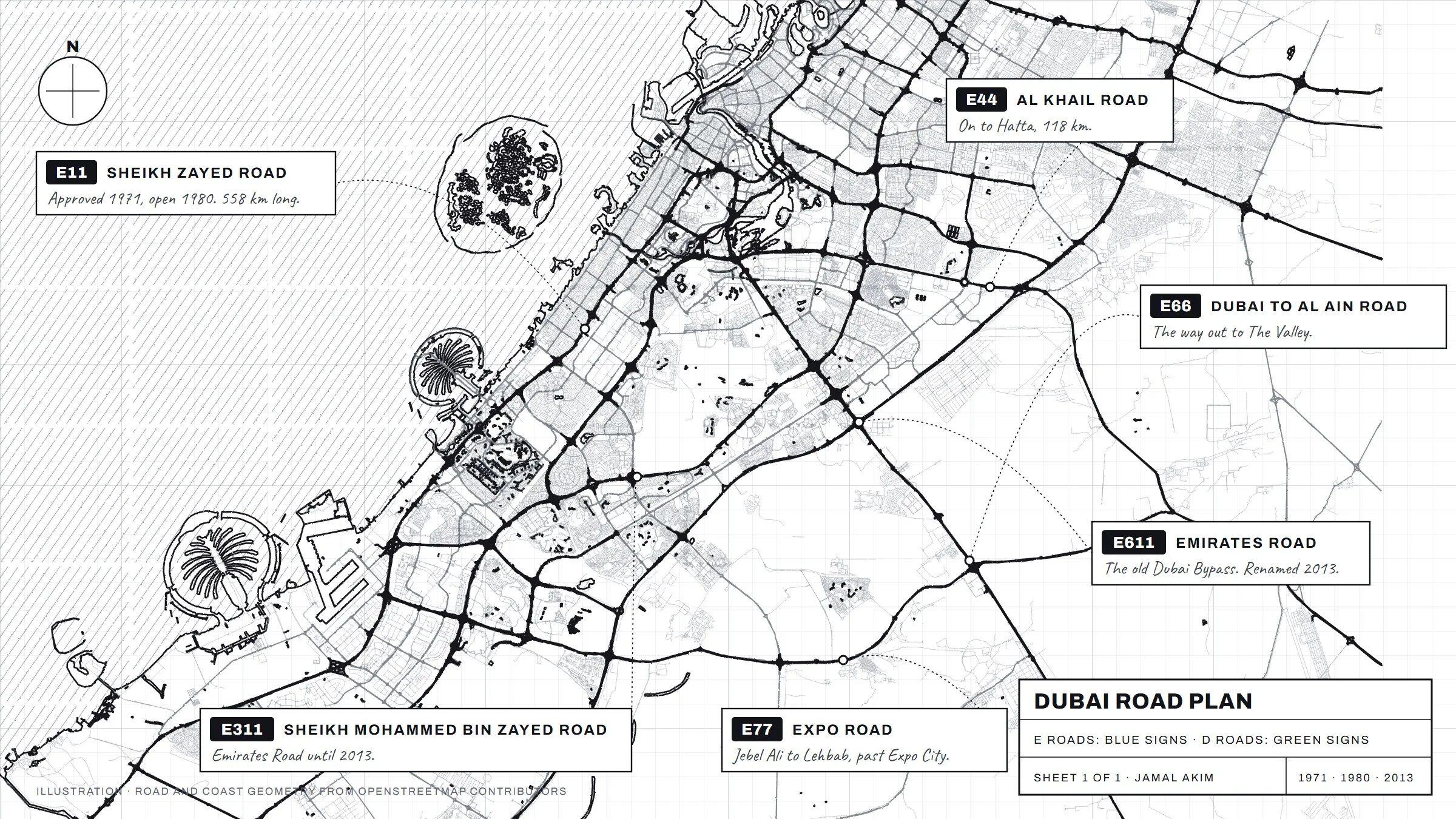
In every country I have worked in, the roads tell you where a city has been and where it is going. London grew along its rail lines. Dubai grew along its highways.
When I talk about the fundamentals, the things that stay true whatever you are buying, roads are one of them. Jobs, schools and shops only matter if people can reach them. So before we look at a single building, it helps to understand the system the city is built on.
E roads and D roads: what the letters mean
Every main road in the UAE has a number, and the letter in front tells you what kind of road it is.
E roads are the Emirates roads. They are the big highways that connect one emirate to another, and they carry the most traffic at the highest speeds. The system was adopted in 1995. On signs, E roads are shown in blue. Sheikh Zayed Road is E11.
D roads are Dubai’s own roads. They are the city’s internal network, run by Dubai’s Roads and Transport Authority, and shown on green signs. They are shorter, and they connect communities to the E roads.
D road numbers follow a simple pattern:
- Roads that run parallel to the coast have even numbers, starting at D 94 by the sea and getting smaller as you move inland.
- Roads that run from the coast inland have odd numbers, getting bigger as you move towards Sharjah.
So even without a map, a D road number tells you roughly where you are and which way it runs. Street names change, sometimes more than once along the same road, so the number is usually the most reliable way to describe a location.
E11: the road that built a country
Before 1980 there was no proper road between the UAE’s two biggest cities. Abu Dhabi and Dubai were connected by desert tracks, and the trip took around four hours.
The highway was approved and construction began in 1971, the year the UAE was founded, and it was finished in 1980. The Dubai World Trade Centre went up beside it in 1979, one of the first towers of what became the region’s most famous skyline.
In the 1990s, Sheikh Maktoum bin Rashid, then Ruler of Dubai, named the Dubai section Sheikh Zayed Road in honour of the UAE’s founding President. Abu Dhabi returned the gesture and named its section after Sheikh Maktoum. The same road is also called Al Ittihad Road, “the Union road”, in Sharjah and Ajman.
Today E11 runs about 558 km, from the Saudi border in the west to Ras Al Khaimah in the north. It is the longest road in the UAE, and it does exactly what it was built to do: tie the emirates together.
For property, it is the spine. The Marina, JBR, the Palm, Downtown, DIFC and Business Bay all line up along it, and the first band of my five zones is simply the coast to E11.
E311 and E611: the two inland spines
As Dubai grew, it needed more roads running parallel to E11 to carry traffic past the city.
E311 is Sheikh Mohammed Bin Zayed Road. Until January 2013 it was called Emirates Road. Sheikh Mohammed bin Rashid renamed it in honour of Sheikh Mohammed bin Zayed, then Crown Prince of Abu Dhabi, calling it a vital artery connecting and uniting the emirates.
E611 is today’s Emirates Road. It used to be the Dubai Bypass Road, and took the Emirates Road name in 2013. It runs about 110 km from Abu Dhabi to Ras Al Khaimah, around the outside of the city.
If the names confuse you, you are not alone: “Emirates Road” has been two different roads. This is why I always use the numbers.
Between them, these three roads split Dubai into bands running inland from the sea, and that is how I draw the zones on my map:
- The coast to E11: the established core.
- E11 to E311: the spine of the city and its family belt, from Downtown to Dubai Hills and JVC.
- E311 to E611: space-led suburbs like Arabian Ranches, DAMAC Hills and Mudon.
- Beyond E611: outer growth, like Town Square, DAMAC Hills 2 and The Valley.
The roads running inland
The other big E roads run away from the coast, and they decide how the inland communities connect to the city:
- E44, Al Khail Road, becomes the Dubai to Hatta road. It runs 118 km and even crosses briefly through Oman. Dubai awarded a Dh700 million contract in 2024 to upgrade the Al Khail Road stretch, which matters to the communities that rely on it.
- E66, the Dubai to Al Ain Road, now named Tahnoun Bin Mohammed Al Nahyan Road. It is the main route for communities like The Valley and Sobha Sanctuary on the way out of the city.
- E77, Expo Road, runs from Jebel Ali past Dubai Investments Park and Dubai South to Expo City, and on towards Hatta. It was renamed and widened for Expo 2020, and it is the backbone of the southern corridor, my fifth zone.
Beyond the roads: rail
Roads are no longer the whole story. Etihad Rail started its first passenger services in 2026, between Abu Dhabi and Fujairah, with Dubai stations to follow. Abu Dhabi to Dubai is set at around 57 minutes, and a separate high-speed line is planned at around 30 minutes, with stops at Al Maktoum International Airport and Al Jaddaf.
A rail station changes who can live somewhere and still work somewhere else. That is exactly the kind of shift that moves demand, but only once it is running, not when it is announced. Dates and stations change, so check Etihad Rail’s own announcements before relying on them.
How I use roads when I judge a property
Roads appear in almost every assessment I do. These are the questions I ask:
- What is the drive at 8am? Not the drive at midday on a Saturday. A villa 25 minutes from the office on Google can be 55 minutes in the school run.
- Which exit, and which side of the road? Two communities on the same highway can feel completely different depending on whether the exit is easy or you queue for a U-turn.
- How many ways in and out? A community with access to two E roads holds up better when one of them is jammed or under works.
- Is the new road real? A road that is approved, funded and under construction is a reason to look. A road on a render is not rent you can bank.
- Is it too close? Being near a highway is good. Backing onto one is noise, and noise affects rent and resale.
The point
Roads are part of the water, not the flavour. Whatever you are buying, whether it is an apartment for rent, a family villa or a plot, how people get to it shapes who wants it and what they will pay.
If you want to see where a specific community sits on this system, open the community map, switch on the zones, or book a call and we will go through it together.
Road names, numbers and lengths are taken from the sources listed below. Rail dates and stations are as announced at the time of writing and can change. This is general information, not investment advice.
Frequently asked questions
What is the difference between E roads and D roads in the UAE?
E roads are the Emirates roads, the highways connecting one emirate to another, shown on blue signs. D roads are Dubai's internal roads, run by the RTA and shown on green signs. Coast-parallel D roads have even numbers and inland roads have odd numbers.
When was Sheikh Zayed Road built?
Construction began in 1971, the year the UAE was founded, and finished in 1980. Before that, Abu Dhabi and Dubai were linked by desert tracks and the trip took around four hours. Today E11 runs about 558 km from the Saudi border to Ras Al Khaimah.
Which road is Emirates Road in Dubai?
Today's Emirates Road is E611, the former Dubai Bypass Road, renamed in 2013. The road previously called Emirates Road is E311, renamed Sheikh Mohammed Bin Zayed Road in January 2013.
How do roads affect property values in Dubai?
They decide how quickly people reach jobs and schools. Check the drive at 8am, which exit a community uses, how many ways in and out it has, whether a promised road is actually funded and under construction, and whether a home backs onto a highway.
Sources
- Wikipedia: Dubai route numbering system
- Wikipedia: E 11 road (United Arab Emirates)
- The National: the UAE's longest road has many names
- Gulf News: E11, the road that unites the UAE
- Khaleej Times: Mohammed renames Emirates Road (E311)
- Gulf News: Dubai Bypass Road renamed Emirates Road (E611)
- Wikipedia: E 611 road (United Arab Emirates)
- Wikipedia: E 44 road (United Arab Emirates)
- Wikipedia: E 66 road (United Arab Emirates)
- The National: Expo Road name change for a stretch of E77
- Gulf News: Etihad Rail passenger service guide
- WAM: Etihad Rail passenger services connecting 11 cities
Considering an investment in Dubai?
Send me your budget, timeframe and objective and I'll give you my view on where I'd start.