
Before you apply: the UAE mortgage documents checklist
The fastest mortgage approvals I see aren’t the ones with the biggest salaries.
They’re the ones where the buyer sent everything, first time, in order.
Banks don’t move slowly because they’re difficult. They move slowly because they’re waiting for a document. So here’s the list. Save it.
Key takeaways
- Every UAE bank checks the same things: who you are, what you earn, what you owe, and where your deposit comes from.
- Salaried: ID, salary certificate, payslips, 3 to 6 months of bank statements, credit report.
- Self-employed: add a trade licence, 2 years of audited accounts and 6 to 12 months of business statements.
- Your deposit must be your own money. Central Bank rules don’t allow it to come from a personal loan or credit card.
- Before you apply, cut your debts. Every commitment reduces what you can borrow.
Salaried UAE residents
| Document | What to check |
|---|---|
| Passport and residence visa | Valid for the whole application |
| Emirates ID | Front and back, in date |
| Salary certificate | On company letterhead, recent, showing basic salary and allowances |
| Payslips | Usually the last 3 to 6 months |
| Personal bank statements | Usually 3 to 6 months, showing your salary arriving |
| Credit report (AECB) | Banks pull it, but check your own first for surprises |
| Existing loan and card statements | Every car loan, personal loan and credit card |
If you’re salaried, earning AED 10,000 or more and buying a ready home, you may qualify for an instant pre-approval, where the bank verifies you digitally with your Emirates ID. I explain it in my pre-approval guide.
Self-employed and business owners
GCC Mortgages lists these for self-employed applicants:
| Document | Typical requirement |
|---|---|
| Passport, visa, Emirates ID | As above |
| Trade licence | Current, plus proof of how long the business has traded (2+ years typical) |
| Memorandum of Association | Showing your shareholding |
| Chamber of Commerce certificate | Where applicable |
| Audited financial statements | Usually 2 years |
| Business bank statements | 6 to 12 months |
| Personal bank statements | 6 months |
| Existing loan and card statements | All of them |
The detail that matters most is which bank you go to. Banks assess business income differently. More in my self-employed guide and GCC’s self-employed mortgage page.
Buying from abroad
Non-residents generally need the same identity and income documents, plus proof of address abroad, a credit report from their home country and, for some banks, statements from overseas accounts. Deposits are larger. Here’s the non-resident guide.
The property documents
Once you’ve found the home, the bank also needs:
- The signed Memorandum of Understanding (Form F) for a resale, or the sale and purchase agreement and developer statement of account for off-plan or handover.
- A copy of the title deed or Oqood.
- Access for the bank’s valuer.
The money rules most people miss
1. Your deposit must be yours. The Central Bank’s rules say the down payment must come from the borrower’s own resources, not from personal loans or credit cards. Banks check where it came from, so keep the trail clean: savings, a sale, a gift with a letter.
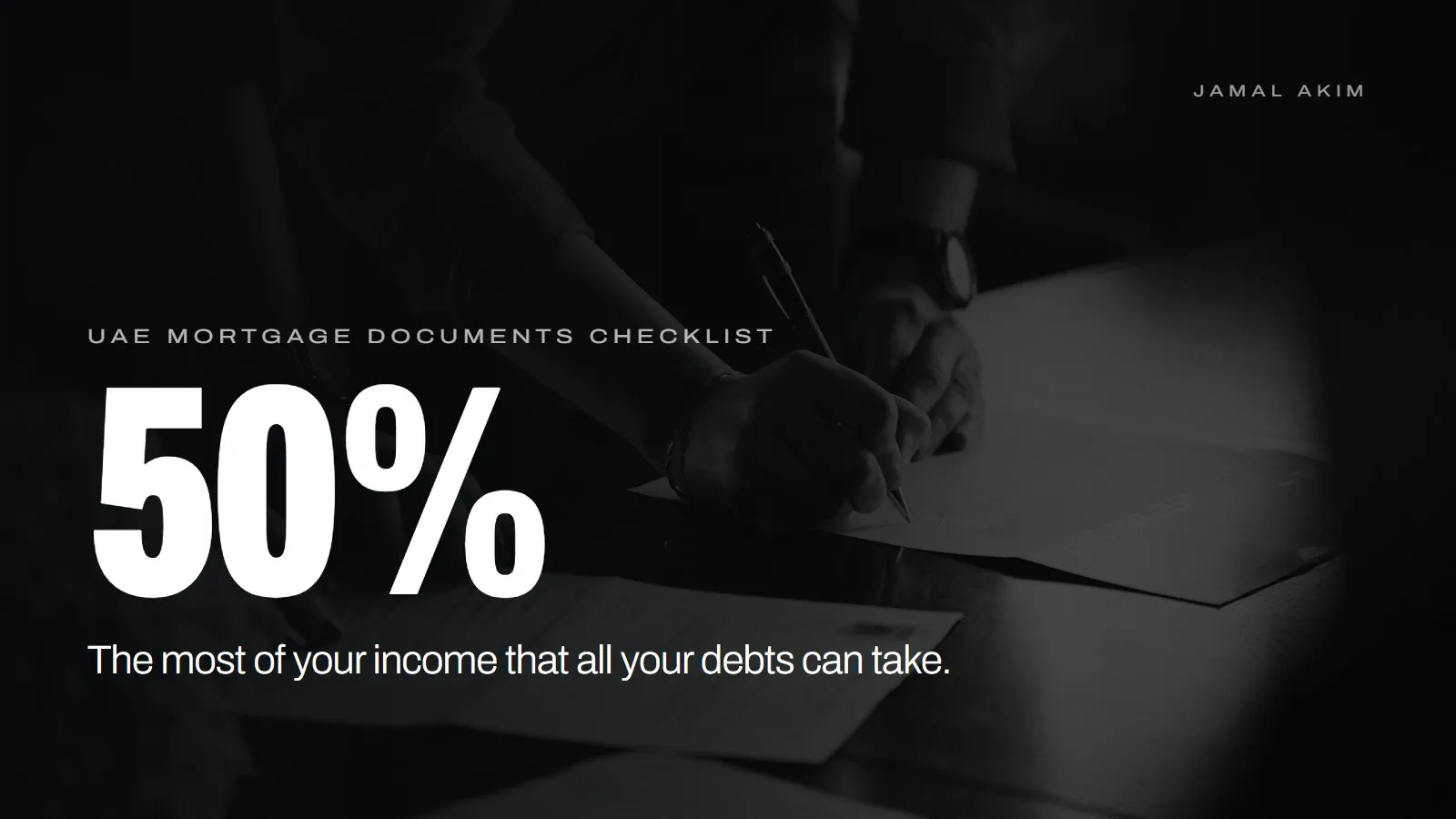
2. 50% is the ceiling, not the target. Your total monthly debts, including the new mortgage, can’t exceed 50% of your income. Banks are told not to automatically lend to the maximum.
3. Banks stress-test you. The rules require lenders to check you could still pay if rates rose 2 to 4 percentage points.
4. Bonuses may not count. Only reliable, sustainable income counts. Bonuses and other non-guaranteed income are discounted or left out.
5. End-of-service benefits can’t repay the loan. The rules don’t allow banks to rely on your gratuity for repayments.
Six things to do before you apply
- Close credit cards you don’t use. Many banks count part of the limit as debt even if the balance is zero.
- Clear small loans if you can. A car loan can cost you far more in borrowing power than it saves.
- Don’t change jobs mid-application. Many banks want a minimum time with your employer.
- Pull your credit report. Fix errors before a bank sees them.
- Keep your salary arriving in one account and avoid large unexplained transfers.
- Budget for fees, not just the deposit. A mortgage adds its own costs. Here’s every fee explained.
Applying with a partner
Joint applications are common, and they can lift what you can borrow. A few things to know:
- Both incomes count, and so do both people’s debts. A partner’s car loan reduces the joint limit.
- Both people provide the full document set. ID, income proof, statements and a credit report for each.
- Both are usually on the title deed and both are responsible for the whole loan, not half each.
- The instant pre-approval route is for single applicants. Joint cases go through the standard route, which GCC Mortgages aims to complete within 48 hours.
Your credit report: check it before the bank does
Every UAE bank checks your report from the Al Etihad Credit Bureau (AECB). It lists your loans, cards, limits and repayment history, and gives a score. You can order your own report from the AECB.
What to look for:
- Cards or loans you thought were closed. A closed account still showing an open limit counts against you.
- Late payments. Even small ones on a phone bill can appear.
- Limits you don’t use. Ask the bank to lower or close them before you apply.
Fixing an error takes time, so check a few months before you plan to apply.
What a good salary certificate shows
Banks reject more salary certificates than you’d think. A good one:
- Is on company letterhead, signed and stamped, and recent (most banks want it issued within the last month).
- States your basic salary and each allowance separately: housing, transport and so on.
- Confirms your job title and start date.
- Matches what arrives in your bank statements to the dirham.
If part of your pay is commission or bonus, ask HR to show it separately. Banks treat guaranteed pay and variable pay differently; the Central Bank’s rules say non-guaranteed income should be discounted or excluded.
Gifted deposits
Family helping with the deposit is fine, but banks need to see it’s a gift, not a loan. Expect to provide:
- A signed gift letter saying the money doesn’t need to be repaid.
- The giver’s ID.
- Statements showing the money leaving their account and arriving in yours.
The Central Bank’s rule is clear: the deposit can’t come from other borrowing.
The timeline, from documents to keys
| Step | Typical time |
|---|---|
| Gather documents | A few days, if you start early |
| Pre-approval | Minutes (instant route) to 48 hours (standard) |
| Find a property and sign the MOU | Your search |
| Bank valuation | 3 to 7 working days |
| Final offer letter | A few days after valuation |
| DLD transfer | Booked once the bank is ready |
Timings as described by GCC Mortgages; each bank works to its own pace. A complete file is the single biggest thing that keeps it moving.
Self-employed: extra tips on paperwork
- Make sure the name on your trade licence matches your passport exactly.
- Have two years of audited accounts signed by the auditor, not management accounts.
- Keep business and personal accounts separate. Mixed accounts are harder for a bank to read.
- If you pay yourself a salary, keep it regular and on the same date each month.
More in my self-employed guide.
Non-residents: the documents in detail
Buying from abroad, expect to provide:
| Document | Notes |
|---|---|
| Passport | Valid, with a clear copy |
| Proof of address abroad | A recent utility bill or bank statement |
| Income proof | Salary certificate and payslips, or audited accounts if self-employed |
| Bank statements | Usually six months, from the account your income is paid into |
| Credit report from your home country | Some banks require it; others check their own way |
| Tax returns | Where your country issues them, often requested for business owners |
Deposits for non-residents are larger, typically 40% to 50% on a completed property. Here’s the full non-resident guide.
Documents for an off-plan handover
If the mortgage is for a handover payment, the bank also needs:
- The sale and purchase agreement.
- The Oqood (the DLD’s off-plan registration).
- An up-to-date statement of account from the developer, showing what you’ve paid and what’s due.
- The developer’s handover notice, if issued.
Ask the developer for the statement early; it can take a while. More on handover mortgages and 20/80 plans.
On transfer day
At the DLD trustee office you’ll need:
- Original passport and Emirates ID (or valid visa) for every buyer.
- The bank’s cheques and the final offer letter, coordinated by the bank.
- Manager’s cheques or payments for fees, as the trustee directs.
- A registered power of attorney if someone signs for you. GCC Mortgages covers this on its power of attorney page.
If you live abroad and can’t attend, arrange the power of attorney well before the date.
Common reasons applications get delayed
- An old salary certificate. Most banks want one issued in the last month.
- Statements with gaps. Missing months, or pages, stop the file.
- Name mismatches. A different spelling on your passport, visa and licence needs explaining.
- Unexplained large deposits. Be ready to show where big transfers came from.
- A missing credit report from abroad, for non-residents whose bank requires one.
- A property the bank can’t lend on. Check before you sign the MOU.
Send everything at once, clearly labelled, and you avoid most of these.
Glossary
- AECB: the Al Etihad Credit Bureau, which keeps the credit reports UAE banks check.
- Debt burden ratio (DBR): all your monthly debt payments as a share of income. The UAE maximum is 50%.
- Loan-to-value (LTV): the loan as a percentage of the property’s value. An 80% LTV means a 20% deposit.
- Form F (MOU): the memorandum of understanding signed by buyer and seller on a Dubai resale.
- Oqood: the DLD’s registration of an off-plan purchase, before a title deed exists.
- Registration trustee office: the DLD-approved office where the transfer and mortgage registration happen.
- Audited accounts: financial statements checked and signed by an independent auditor, which banks prefer to management accounts.
Keep a digital folder
Save every document as a clear PDF, named plainly: “Passport”, “Salary certificate October 2026”, “Bank statements May to October”. Keep one folder per applicant. When the bank or broker asks for something, you send it in minutes, not days, and you’ll reuse most of it later for a refinance or a second purchase. Update the salary certificate and statements every month while you search, so they never go out of date mid-application. A tidy file is the quickest way to a yes.
Ready?
Gather the list, then get your number. Start with GCC Mortgages or send me three answers and I’ll introduce you.
General information, not mortgage or financial advice. Banks set their own document requirements and may ask for more. I don’t receive a fee from GCC Mortgages for introductions; we work together and refer clients to each other.
Frequently asked questions
What documents do I need for a mortgage in the UAE?
Salaried applicants usually need a passport, visa and Emirates ID, a salary certificate, recent payslips, three to six months of bank statements and a credit report. Self-employed applicants also need a trade licence, two years of audited accounts and business bank statements.
Can I borrow my deposit with a personal loan?
No. UAE Central Bank rules say the down payment must come from your own resources, not from other borrowing such as personal loans or credit cards.
Does my credit card limit affect how much I can borrow?
Yes. Banks count your existing commitments when they check the 50% debt burden limit, and many count part of your card limits even if you pay them off each month.
How many months of bank statements do UAE banks want?
Usually three to six months of personal statements for salaried applicants, and six to twelve months of business statements for self-employed applicants.
Sources
- Central Bank of the UAE Rulebook: Regulations Regarding Mortgage Loans (DBR, down payment from own resources, income verification)
- GCC Mortgages: Self-employed mortgage UAE (requirements and documents)
- GCC Mortgages: Handover mortgage Dubai (pre-approval documents)
- GCC Mortgages: Instant mortgage pre-approval
Considering an investment in Dubai?
Send me your budget, timeframe and objective and I'll give you my view on where I'd start.